Skip to content


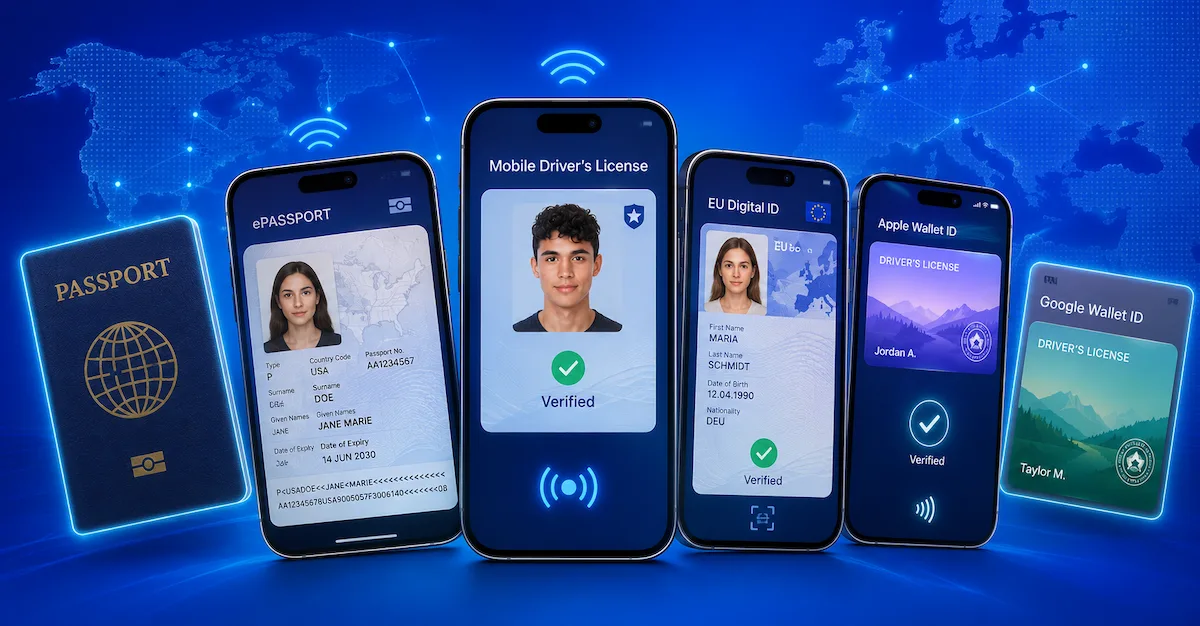

A few years ago, mobile driver’s licenses (mDLs) were viewed as an emerging technology with limited real-world applications. Early deployments were confined to pilot programs, supported by only a handful of states and accepted by relatively few businesses. In 2026, that landscape looks dramatically different.
Across the United States, more states have launched mobile ID programs or announced plans to do so, while major technology providers including Apple, Google, and Samsung continue expanding support for digital credentials within their mobile wallets. The Transportation Security Administration (TSA) now accepts mobile IDs at an increasing number of airport checkpoints, financial institutions are evaluating digital credentials for identity verification, and businesses across retail, hospitality, gaming, cannabis, automotive, and logistics are preparing for a future where customers increasingly present digital credentials instead of physical cards.
At the same time, digital identity is evolving beyond driver’s licenses. Electronic passports (ePassports), digital travel credentials, and government-issued digital identity wallets are becoming central to how consumers prove who they are online and in person. Internationally, governments are investing heavily in national digital identity programs that enable citizens to securely access government services, financial institutions, healthcare providers, and private businesses using cryptographically secured credentials rather than traditional physical documents.
For businesses, this shift represents both an opportunity and a challenge. Digital identities offer stronger security, improved customer privacy, and significantly greater resistance to fraud than traditional visual inspection of a plastic card. However, accepting these credentials requires businesses to understand new technologies, evolving standards, and compatible identity verification systems.
This guide provides a comprehensive overview of the mobile ID ecosystem as it exists in 2026. Whether you’re evaluating digital ID acceptance for a retail store, dispensary, casino, hotel, financial institution, or enterprise security program, understanding how these credentials work, and how to verify them, has become increasingly important.
What is a mobile driver’s license (mDL)?
A mobile driver’s license (mDL) is a government-issued digital version of a physical driver’s license or identification card that is securely stored on a smartphone or other compatible mobile device. Unlike a photograph or PDF of a driver’s license, a mobile ID is a cryptographically signed credential issued directly by the licensing authority, typically a state Department of Motor Vehicles (DMV) or equivalent agency.
Mobile driver’s licenses are commonly referred to by several different names, including digital IDs, mobile IDs, electronic IDs (eIDs), and digital driver’s licenses. While these terms are often used interchangeably, most U.S. programs follow the international ISO/IEC 18013-5 standard, which defines how mobile driver’s licenses are securely stored, presented, and verified.
Rather than displaying all personal information on a screen, mobile IDs allow users to share only the specific information required for a transaction. For example, a retailer verifying the legal age of a customer may only receive confirmation that the customer is over 21, while a secure facility may request the customer’s full name and photograph. This concept, known as selective disclosure, provides greater privacy than presenting a traditional physical ID where every piece of printed information is visible.
Another significant difference is authentication. Accessing a mobile ID generally requires biometric verification through facial recognition or fingerprint authentication before any information can be shared. Because the credential is digitally signed by the issuing authority and protected by the secure hardware built into modern smartphones, mobile IDs are substantially more difficult to counterfeit than traditional plastic identification cards.
While physical driver’s licenses will continue to play an important role for the foreseeable future, mobile IDs represent the next evolution of government-issued identity credentials, combining stronger security with improved convenience and enhanced privacy protections.
Mobile ID terminology
| Term | Description |
| Mobile Driver’s License (mDL) | A digital driver’s license issued by a government authority that follows the ISO/IEC 18013 standard. |
| Digital ID | A broad term encompassing government-issued digital credentials, digital identity wallets, and other electronic identity documents. |
| Mobile ID | A common term used interchangeably with mDL, although it may also include digital state identification cards. |
| Electronic ID (eID) | A digital identity credential issued by a government, commonly used outside the United States. |
| Digital Wallet | An application such as Apple Wallet, Google Wallet, Samsung Wallet, or a state-issued app that securely stores digital credentials. |
How mobile IDs work
Although using a mobile driver’s license often appears as simple as tapping a phone or scanning a QR code, the technology behind these credentials is significantly more sophisticated than storing a picture of an ID on a device.
The process begins with identity issuance. Before a resident can receive a mobile ID, they must already possess a valid physical driver’s license or identification card issued by their state. During enrollment, the issuing authority verifies the applicant’s identity through a combination of document validation, facial recognition, and existing DMV records. Many states also require additional verification steps, such as confirming the resident’s address or using device-based security measures to ensure the credential is installed on a trusted smartphone.
Once approved, the mobile credential is digitally signed by the issuing authority and stored within the secure hardware environment of the user’s device. On Apple devices, this involves the Secure Element and secure enclave technologies, while Android devices utilize comparable hardware-backed security features. The credential cannot simply be copied to another device or extracted like an image file, providing a much higher level of protection against theft or duplication.
When the user presents their mobile ID, the verification process differs substantially from presenting a physical card. Rather than visually displaying all information, the smartphone establishes a secure communication channel, typically using Near Field Communication (NFC), Bluetooth, or an encrypted QR code, with the verifier’s device. After the user authenticates with Face ID, Touch ID, or another biometric method, only the requested data elements are transmitted.
The receiving business then validates that the credential was issued by the appropriate government authority and has not been altered or revoked. Because this exchange is digitally signed and encrypted, businesses gain a much higher level of confidence in the authenticity of the credential than is possible through visual inspection alone.
This architecture is one of the primary reasons mobile IDs are expected to play an increasingly important role in combating identity fraud. Rather than relying on employees to recognize sophisticated counterfeit documents, businesses can verify digitally authenticated credentials that originate directly from trusted issuing authorities.
Why businesses should prepare now
The conversation surrounding mobile IDs is no longer focused on whether businesses should prepare for digital credentials, it is increasingly about how quickly they can adapt.
Consumer adoption continues to accelerate as more states introduce mobile driver’s licenses and integrate them with popular digital wallets. At the same time, government agencies, airports, financial institutions, and private businesses are expanding the number of scenarios where digital credentials can be presented instead of traditional plastic IDs.
For organizations that routinely verify age or identity, this shift creates new operational considerations. Employees who have been trained to inspect physical security features such as holograms, ultraviolet printing, microprinting, or laser engraving must now understand how to accept digitally presented credentials. Businesses also need verification technology capable of securely communicating with mobile wallets while maintaining compliance with evolving state regulations and industry standards.
The benefits, however, extend well beyond convenience. Properly implemented mobile ID verification can reduce counterfeit document fraud, improve customer privacy through selective disclosure, streamline verification workflows, and create a more consistent user experience across both physical and digital channels. As remote identity verification continues to grow, many of the same technologies supporting mobile driver’s licenses are also expected to influence online onboarding, account recovery, and digital identity verification.
Organizations that begin preparing today will be better positioned as adoption expands over the coming years. Rather than viewing mobile IDs as a replacement for physical identification, businesses should recognize that they are entering a period where both credential types will coexist. Verification systems must therefore be capable of accurately accepting physical driver’s licenses, mobile IDs, ePassports, and emerging digital travel credentials within a single workflow.
Mobile ID adoption across the United States
When the first mobile driver’s licenses became available in the United States, they were largely viewed as experimental technology. Early programs focused on proving that digital credentials could be securely issued and accepted, with adoption limited to a handful of states and a relatively small number of businesses equipped to verify them.
By 2026, mobile IDs have transitioned from pilot projects to an increasingly mainstream form of government-issued identification. Numerous states now issue digital driver’s licenses or identification cards through their own mobile applications, while others allow residents to store their credentials directly in Apple Wallet, Google Wallet, Samsung Wallet, or a combination of supported digital wallets. The Transportation Security Administration (TSA) has continued expanding acceptance at airport security checkpoints, and more businesses are beginning to support digital identity verification alongside traditional physical IDs.
Despite this progress, there is still no single nationwide implementation. Each state determines how its mobile ID program is issued, which digital wallets are supported, whether a standalone state application is offered, and how businesses are expected to verify the credential. Some jurisdictions have embraced the ISO/IEC 18013-5 standard and partnered with major wallet providers, while others continue to rely on proprietary applications or remain in active development.
This decentralized approach reflects the same structure used for physical driver’s licenses in the United States. Rather than a federal driver’s license, each state remains responsible for issuing and managing its own credentials. As a result, businesses operating across multiple states must be prepared to encounter several different mobile ID implementations while still providing a consistent customer experience.
Fortunately, industry standards have begun reducing this complexity. The widespread adoption of ISO/IEC 18013-5 has enabled technology providers, government agencies, and identity verification companies to build interoperable solutions capable of accepting multiple types of mobile credentials. While implementation details still vary between jurisdictions, the overall user experience has become significantly more standardized than it was just a few years ago.
The current mobile ID landscape
Although every program has unique characteristics, most state-issued mobile IDs now fall into one of three categories.
The first are native wallet credentials, where residents add their driver’s license directly to Apple Wallet, Google Wallet, Samsung Wallet, or another supported digital wallet. These credentials leverage the security features built into modern smartphones and typically communicate using NFC or encrypted Bluetooth connections.
The second category consists of state-issued mobile ID applications. Rather than relying on a third-party wallet, these programs provide residents with a dedicated application developed by the state or one of its technology partners. Many of these applications also comply with the ISO standard and can be accepted by compatible verification systems.
Finally, a small number of jurisdictions continue to operate pilot programs or limited deployments, while others are actively developing new platforms following legislative approval or procurement efforts.
For businesses, the important distinction is not necessarily which wallet a customer uses, but whether their identity verification technology can securely read and validate the credential regardless of how it is presented.
U.S. Mobile Driver’s License Status (2026)
| Alabama | |||
| Alaska | Live via Alaska Mobile ID app | ||
| Arizona | Live via Apple Wallet and Google Wallet | ||
| Arkansas | Live via Google Wallet, Apple Wallet, Samsung Wallet and Arkansas MiD | ||
| California | Live via Apple Wallet and Google Wallet | ||
| Colorado | Live via Apple Wallet, Google Wallet, Samsung Wallet, and Colorado MiD | ||
| Connecticut | Announced | ||
| Delaware | Live via MID app | ||
| Florida | Pulled from App Stores | ||
| Georgia | Live via Apple Wallet, Google Wallet, and Samsung Wallet | ||
| Hawaii | Live via Apple Wallet | ||
| Idaho | Exploratory | ||
| Illinois | Live via Apple Wallet | ||
| Indiana | Exploratory | ||
| Iowa | Live via MID app, Apple Wallet, Google Wallet, and Samsung Wallet | ||
| Kansas | |||
| Kentucky | Live via Kentucky MiD app | ||
| Louisiana | Live via LA Wallet app | ||
| Maine | |||
| Maryland | Live via Apple Wallet, Google Wallet, and Samsung Wallet | ||
| Massachusetts | |||
| Michigan | Exploratory | ||
| Minnesota | Legal as of 2022 | ||
| Mississippi | Live via MID app | ||
| Missouri | App removed | ||
| Montana | Live via Apple Wallet and Google Wallet | ||
| Nebraska | |||
| Nevada | Exploratory | ||
| New Hampshire | Exploratory | ||
| New Jersey | Exploratory | ||
| New Mexico | Live via Apple Wallet and Google Wallet | ||
| New York | Live via mID app, Apple Wallet, and Google Wallet | ||
| North Carolina | Coming soon | ||
| North Dakota | Live via Apple Wallet and Google Wallet | ||
| Ohio | Live via Apple Wallet | ||
| Oklahoma | App removed due to ADA non-compliance. Google Wallet version available | ||
| Oregon | |||
| Pennsylvania | Exploratory | ||
| Puerto Rico | Live via Apple Wallet and Google Wallet | ||
| Rhode Island | |||
| South Carolina | Exploratory | ||
| South Dakota | |||
| Tennessee | Announced | ||
| Texas | Exploratory | ||
| Utah | Live via GetMobileID | ||
| Vermont | Announced | ||
| Virginia | Pilot in progress | ||
| Washington | |||
| Washington D.C. | Legal as of 2022 | ||
| West Virginia | Live via West Virginia MiD and Samsung Wallet | ||
| Wisconsin | |||
| Wyoming | Coming soon |
What has changed since 2024?
The pace of mobile ID adoption has accelerated considerably over the past two years. While 2024 was largely defined by new state launches and the rapid expansion of Apple Wallet support, the focus in 2025 and 2026 has shifted toward interoperability, broader wallet compatibility, and increased acceptance by government agencies and private businesses.
Several states that were previously operating pilot programs have moved to full public availability, while others have expanded beyond proprietary applications by supporting additional digital wallets. In parallel, technology providers have continued working toward a more standardized experience that allows businesses to accept mobile credentials without maintaining separate workflows for every issuing jurisdiction.
Not every rollout has progressed on schedule. As with many large government technology initiatives, some states have delayed deployments to improve accessibility, strengthen security, or modernize existing infrastructure. Others have revised procurement strategies or selected new technology partners before moving forward with public launches. These delays underscore the importance of relying on official state announcements rather than assuming legislative approval immediately results in a publicly available credential.
The broader trend, however, is unmistakable. More states are investing in digital identity programs, more consumers are becoming familiar with presenting credentials from their smartphones, and more organizations are preparing to support both physical and digital forms of identification as part of everyday operations.
The global expansion of digital identity
While mobile driver’s licenses have gained significant momentum in the United States, they represent only one part of a much larger transformation occurring worldwide. Many countries have spent years investing in national digital identity programs that extend far beyond driver’s licenses, enabling citizens to securely access government services, healthcare, banking, travel, and private-sector applications using trusted digital credentials.
Unlike the United States, where driver’s licenses are issued individually by each state, many countries operate under centralized national identity systems. This allows governments to develop unified digital identity platforms that can be deployed nationwide rather than coordinating across dozens of independent issuing authorities. As a result, many international programs have expanded more rapidly and support a broader range of everyday services.
Although implementation varies from country to country, the overall direction is consistent. Governments are moving toward secure, privacy-focused digital identities that allow individuals to prove specific attributes, such as age, identity, residency, or driving privileges, without unnecessarily exposing additional personal information. This same philosophy of selective disclosure that underpins modern U.S. mobile driver’s licenses is becoming a global standard.
For businesses operating internationally or serving travelers from around the world, understanding these evolving digital identity ecosystems is becoming increasingly important. Hotels, financial institutions, retailers, rental car agencies, airlines, and border authorities are all preparing for a future where digital credentials become as commonplace as physical documents.
Europe is building a unified digital identity ecosystem
Perhaps the most ambitious digital identity initiative underway is the European Union’s European Digital Identity Wallet (EUDI Wallet). Rather than creating separate systems for each member country, the European Union is working toward a standardized framework that allows citizens to use trusted digital credentials across all participating member states.
The EUDI Wallet is designed to store far more than a digital identity card. Depending on the country and implementation, citizens may eventually use the wallet to store driver’s licenses, professional certifications, university diplomas, healthcare credentials, travel documents, and payment information. Individuals will also have greater control over which pieces of information they share during each transaction, helping improve privacy while reducing unnecessary data collection.
For businesses, the long-term significance of the EUDI Wallet extends beyond Europe. Many of the technical standards and privacy principles being developed through the European initiative are influencing digital identity programs globally, including future remote identity verification systems used by financial institutions and regulated industries.
As cross-border interoperability improves, businesses may eventually encounter customers presenting digital credentials issued by governments outside their own country, making standards-based verification increasingly valuable.
Canada continues to expand provincial digital identity programs
Canada has taken a provincial approach to digital identity, with individual provinces leading development while collaborating through broader national digital trust frameworks.
Several provinces have introduced digital identity initiatives focused on accessing government services, healthcare, licensing, and online authentication. While implementation varies across jurisdictions, Canadian programs generally emphasize privacy, consent, and strong encryption, reflecting both provincial privacy legislation and the country’s broader approach to digital identity governance.
Although Canada has not yet implemented a nationwide mobile driver’s license program comparable to the United States, provincial digital identity initiatives continue to mature, and interoperability between government agencies remains a major focus. As these programs expand, businesses operating across North America may increasingly encounter customers presenting digital credentials issued by Canadian provinces.
Asia-Pacific governments continue leading digital identity innovation
Many countries throughout the Asia-Pacific region have been developing digital identity infrastructure for more than a decade, making the region one of the world’s most mature digital identity markets.
Singapore remains one of the most recognized examples, with its Singpass platform allowing residents to securely authenticate their identities across hundreds of government and private-sector services. The platform has become deeply integrated into daily life, supporting everything from banking and healthcare to tax services and business transactions.
Australia has similarly accelerated development of its digital ID framework, building upon existing state-issued digital driver’s licenses while working toward broader interoperability between state and federal services. Several Australian states already offer digital driver’s licenses that are widely accepted within their jurisdictions, providing valuable insight into how government-issued mobile credentials can be integrated into everyday commerce.
Japan, South Korea, Hong Kong, and India have also continued investing heavily in digital identity infrastructure. While each country’s implementation reflects its own legal and regulatory environment, the common objective remains consistent: enabling secure, privacy-conscious identity verification while reducing reliance on paper documents and manual verification processes.
These mature implementations provide valuable examples of how digital credentials can support both public services and private-sector identity verification at scale.
Digital identity is expanding across the Middle East and beyond
The Middle East has also emerged as a global leader in digital government services. Countries such as the United Arab Emirates have invested heavily in comprehensive digital identity ecosystems that integrate government services, financial institutions, healthcare providers, telecommunications companies, and travel applications into a unified digital experience.
Saudi Arabia continues expanding its own digital identity initiatives as part of broader national digital transformation efforts, while other countries throughout the region have introduced secure electronic identity platforms that support both citizen services and commercial transactions.
Outside these regions, countries throughout Latin America, Africa, and Southeast Asia continue launching or expanding digital identity initiatives tailored to their own governmental structures and public service priorities. Although these programs differ considerably in scope and maturity, they collectively demonstrate that digital identity is no longer an emerging concept, it is becoming an expected component of modern government infrastructure.
International digital identity adoption at a glance
The global digital identity landscape varies considerably depending on each country’s regulatory environment and existing identification systems. While some governments focus primarily on digital driver’s licenses, others have developed comprehensive national identity platforms that support a wide range of public and private services.
| Country / Region | Digital ID Program | Mobile Driver’s License | National Digital Identity | Digital Wallet | Current Status |
| United States | State-issued mDLs | ✔ | ✖ | Apple, Google, Samsung, State Apps | Rapid Expansion |
| European Union | European Digital Identity Wallet (EUDI) | Country dependent | ✔ | EUDI Wallet | Rolling out |
| Canada | Provincial Digital ID Programs | Limited | Provincial | Provincial Wallets | Growing |
| United Kingdom | GOV.UK Wallet | Planned | ✔ | GOV.UK Wallet | Early rollout |
| Australia | State Digital Driver Licences | ✔ | Federal Digital ID | Government Wallets | Mature |
| New Zealand | Digital Identity Services Trust Framework | Limited | ✔ | Government Services | Growing |
| Singapore | Singpass | N/A | ✔ | Singpass | Mature |
| Japan | My Number Card | Limited | ✔ | Government Apps | Mature |
| South Korea | Mobile Resident Registration Card | Limited | ✔ | Government Apps | Expanding |
| Hong Kong | iAM Smart | N/A | ✔ | iAM Smart | Mature |
| India | Aadhaar | N/A | ✔ | DigiLocker | Mature |
| United Arab Emirates | UAE Pass | N/A | ✔ | UAE Pass | Mature |
| Saudi Arabia | Absher / Nafath | N/A | ✔ | Government Apps | Mature |
| Norway | BankID | N/A | ✔ | BankID | Mature |
| Sweden | BankID | N/A | ✔ | BankID | Mature |
| Denmark | MitID | N/A | ✔ | MitID | Mature |
As governments continue investing in secure digital credentials, international interoperability will become increasingly important. Businesses that already support standards-based identity verification will be better positioned to accommodate customers presenting digital credentials from a growing number of jurisdictions.
Digital identity is becoming a global standard
Although mobile driver’s licenses often receive the most attention in North America, they represent only one component of a much broader evolution in digital identity. Around the world, governments are developing secure digital credential ecosystems designed to improve privacy, reduce fraud, and simplify interactions between citizens, businesses, and public agencies.
For organizations that verify identities as part of their daily operations, this global momentum reinforces the importance of adopting flexible verification technology rather than solutions tied to a single document format or issuing authority. As standards continue to mature and international adoption accelerates, businesses will increasingly encounter customers presenting a variety of trusted digital credentials alongside traditional physical identification.
The next major evolution extends beyond driver’s licenses entirely. Electronic passports, Digital Travel Credentials (DTCs), and secure mobile travel documents are reshaping how travelers prove their identities around the world.
ePassports and the future of digital travel credentials
While mobile driver’s licenses have received significant attention in recent years, electronic passports (commonly called ePassports) remain the most widely accepted digital identity credential in the world. More than 150 countries now issue biometric passports containing embedded RFID chips, making them one of the largest and most mature digital identity ecosystems ever deployed.
Unlike a traditional passport, an ePassport contains an integrated contactless chip that securely stores the same information printed on the passport’s data page, along with a high-resolution digital photograph and cryptographic security certificates issued by the passport’s issuing authority. Depending on the country, the chip may also contain additional biometric information designed to strengthen identity verification and reduce document fraud.
For travelers, the technology often goes unnoticed. Presenting an ePassport at an airport kiosk or immigration checkpoint may look no different than presenting a traditional passport. Behind the scenes, however, sophisticated cryptographic processes verify that the chip was issued by a legitimate government, that its contents have not been altered, and that the document remains authentic.
This digital verification process makes ePassports significantly more resistant to counterfeiting than traditional travel documents that rely solely on printed security features.
As governments continue modernizing border control systems, the technologies pioneered by ePassports are increasingly influencing how digital driver’s licenses, national digital identities, and future mobile credentials are designed.
How ePassports work
At first glance, an ePassport appears nearly identical to a traditional passport. The key difference is the embedded contactless RFID chip located within the passport cover or data page. This chip contains a digitally signed version of the passport holder’s identity information and communicates wirelessly with compatible readers using Near Field Communication (NFC).
When an ePassport is scanned, the verification device establishes a secure encrypted connection with the chip. Rather than relying solely on visual inspection, the reader verifies multiple layers of digital security before accepting the credential.
The chip’s digital signature is validated against certificates distributed through the International Civil Aviation Organization (ICAO), ensuring the document was issued by a recognized government authority. Additional cryptographic protections help confirm that the chip’s contents have not been modified or copied, while biometric information can be compared against the traveler presenting the document when required.
These verification steps occur within seconds, allowing border officials and other authorized organizations to authenticate passports far more reliably than through manual inspection alone.
The result is a credential that combines the familiarity of a physical passport with the security advantages of modern digital identity technology.
Why ePassports are more secure than traditional passports
For decades, passport security relied primarily on physical features such as holograms, watermarks, ultraviolet inks, microprinting, optically variable inks, and specialized printing techniques. While these protections remain extremely important, advances in document counterfeiting have made it increasingly difficult for even trained personnel to identify sophisticated fraudulent documents through visual inspection alone.
ePassports introduce an entirely new layer of protection by incorporating cryptographic authentication directly into the credential itself.
Instead of asking a document examiner to determine whether a hologram appears genuine, an ePassport reader verifies whether the digital certificate stored within the chip was signed by the issuing government and whether the stored information has remained unchanged since issuance. This dramatically reduces opportunities for tampering while increasing confidence that the document being presented is authentic.
Combined with biometric verification technologies such as facial recognition, ePassports create a substantially stronger identity verification process than traditional visual document inspection.
Beyond airports: Why ePassports matter to businesses
Although ePassports are most commonly associated with international travel, they are increasingly being used in industries far beyond airports and border crossings.
Hotels frequently rely on passports to verify international guests during check-in, while financial institutions often accept passports during customer onboarding and Know Your Customer (KYC) procedures. Car rental agencies, cruise lines, higher education institutions, healthcare organizations, and employers also regularly verify passports as part of identity verification processes.
As global travel continues to recover and international commerce expands, businesses are encountering a growing number of customers who present ePassports instead of domestic driver’s licenses.
Organizations equipped to electronically read passport chips can often complete verification more quickly while obtaining stronger assurance that the document is authentic. Electronic verification also reduces reliance on manual inspection, helping employees identify fraudulent or altered travel documents that may otherwise appear legitimate.
The next evolution: Digital travel credentials
The future of international travel extends beyond physical passports. Governments, technology providers, and international standards organizations are now developing Digital Travel Credentials (DTCs), secure digital versions of passport information that can be stored on a traveler’s smartphone and shared electronically when needed.
Unlike simply taking a photograph of a passport, Digital Travel Credentials are cryptographically linked to the physical passport and issued under internationally recognized standards. This allows travelers to securely share verified identity information before arriving at an airport, during airline check-in, or throughout various stages of the travel experience.
The International Civil Aviation Organization (ICAO), the United Nations agency responsible for global passport standards, has developed the framework for Digital Travel Credentials as part of its long-term vision for modernizing international travel.
Although widespread adoption is still in its early stages, pilot programs are already demonstrating how travelers may eventually move through airports using trusted digital credentials stored directly on their smartphones rather than repeatedly presenting physical documents.
Apple digital IDs and digital passports are accelerating adoption
Consumer technology companies have also played an important role in familiarizing users with digital credentials. Apple has expanded support for government-issued mobile driver’s licenses through Apple Wallet, while also introducing Digital ID capabilities designed to streamline identity verification during travel.
Rather than replacing government-issued documents, these wallet-based credentials securely store digital representations that can be presented only after biometric authentication and user consent. This model closely mirrors the principles used by mobile driver’s licenses: users remain in control of their information, and only the data necessary for a specific transaction is shared.
As additional governments participate and international standards continue to mature, digital wallets are expected to become an increasingly common method for storing not only driver’s licenses, but also passports, travel credentials, and other government-issued identity documents.
Preparing for a future beyond physical documents
Physical passports will remain essential for international travel for many years to come. However, the long-term direction of digital identity is becoming increasingly clear. Governments are investing in cryptographically secured credentials, technology providers are building standardized digital wallet ecosystems, and international organizations are establishing the frameworks necessary for trusted cross-border identity verification.
Businesses that rely on identity verification should view ePassports and Digital Travel Credentials not as separate technologies, but as part of the same broader evolution toward secure, privacy-focused digital identity. Whether verifying a mobile driver’s license, an electronic passport, or a future Digital Travel Credential, the underlying objective remains the same: providing faster, more secure, and more trustworthy identity verification than traditional visual document inspection alone.
How businesses can verify mobile IDs, digital wallets, and ePassports
For decades, verifying an identity document was a largely manual process. An employee would examine a driver’s license or passport, compare the photograph to the individual presenting it, inspect security features such as holograms or microprinting, and determine whether the document appeared legitimate.
That process becomes far more complicated when the credential being presented is digital.
Unlike a physical driver’s license, a mobile ID isn’t designed to be visually inspected. The information stored within the credential is encrypted, digitally signed by the issuing authority, and shared electronically only after the holder authorizes the transaction. In many cases, the customer may never see all of the information being transmitted, and neither should the business. Instead, the verification process relies on secure communication between the customer’s device and the business’s verification system.
This shift fundamentally changes what businesses should expect from an identity verification solution. Rather than simply capturing an image of an ID card, modern verification systems must be capable of securely communicating with multiple types of government-issued credentials while validating that the information originated from a trusted source.
Mobile IDs can be presented in several different ways
One of the biggest misconceptions surrounding mobile driver’s licenses is that every digital credential works the same way. In reality, the presentation method depends on both the issuing authority and the digital wallet used by the customer.
Most modern implementations rely on Near Field Communication (NFC), allowing the customer to simply hold their smartphone near a compatible reader in much the same way they would make a contactless payment. The credential is securely transmitted after the user authenticates with Face ID, Touch ID, a fingerprint, or another biometric method.
Other programs support encrypted Bluetooth communication or generate secure QR codes that establish a trusted connection between the customer’s device and the verifier. Regardless of the underlying technology, the goal remains consistent: allow businesses to verify government-issued credentials without exposing unnecessary personal information or relying solely on visual inspection.
One verification system should support multiple credential types
As digital identity continues to evolve, businesses are unlikely to encounter just one type of credential. A retail associate might verify a traditional plastic driver’s license one moment, an Apple Wallet mobile ID the next, and an international ePassport shortly afterward.
Maintaining separate systems for each credential type would quickly become impractical.
Instead, organizations should look for identity verification platforms designed to support multiple government-issued credentials within a single workflow. This reduces employee training, minimizes operational complexity, and helps future-proof investments as additional states and countries introduce new digital identity programs.
Rather than replacing physical ID scanning, digital identity verification expands the range of credentials businesses can confidently accept.
Digital Identity Credential Comparison
| Credential Type | Physical Card | NFC | QR Code | Bluetooth | Biometric Authentication | Government Issued | Typical Uses | IDScan.net Compatible |
| Driver’s License | ✔ | ✖ | Barcode | ✖ | ✖ | ✔ | Age & Identity Verification | ✔ |
| State ID | ✔ | ✖ | Barcode | ✖ | ✖ | ✔ | Identity Verification | ✔ |
| Mobile Driver’s License (ISO 18013-5) | ✖ | ✔ | Optional | ✔ | ✔ | ✔ | Age & Identity Verification | ✔ |
| Apple Wallet ID | ✖ | ✔ | ✔ | ✔ | ✔ | ✔ | Identity Verification | ✔ |
| Google Wallet ID | ✖ | ✔ | ✔ | ✔ | ✔ | ✔ | Identity Verification | ✔ |
| Samsung Wallet ID | ✖ | ✔ | ✔ | ✔ | ✔ | ✔ | Identity Verification | ✔ |
| State Mobile ID App | ✖ | Varies | ✔ | Varies | ✔ | ✔ | Identity Verification | ✔ |
| ePassport | ✔ | ✔ | ✖ | ✖ | Optional | ✔ | International Travel | ✔ |
| ICAO Digital Travel Credential (DTC) | ✖ | ✔ | ✔ | ✔ | ✔ | ✔ | Future Travel | Roadmap |
| National Digital Identity Wallet | ✖ | Varies | Varies | Varies | ✔ | ✔ | Government & Private Services | Emerging |
Choosing technology that can adapt to future standards
One of the challenges facing businesses today is that digital identity technology continues to evolve. New states launch mobile driver’s licenses each year, international digital identity programs continue expanding, and standards organizations regularly publish updates that improve interoperability and security.
Organizations purchasing verification technology today should therefore consider not only the credentials they need to accept immediately, but also those they may encounter over the next several years.
Solutions built around internationally recognized standards are generally better positioned to support future mobile IDs, additional digital wallet providers, and emerging credential formats without requiring significant hardware replacement or operational changes.
This approach allows businesses to remain flexible as consumer adoption grows and government-issued digital credentials become increasingly common.
How IDScan.net supports digital identity verification
As digital identity adoption has accelerated, IDScan.net has continued expanding its identity verification platform to support both traditional identity documents and emerging digital credentials. Rather than requiring businesses to choose between physical and digital IDs, IDScan.net’s solutions are designed to accommodate both within a unified verification workflow.
For organizations verifying customers in person, VeriScan Identity Platform supports the scanning and authentication of driver’s licenses, state-issued identification cards, military IDs, passports, and many other government-issued credentials. As support for mobile driver’s licenses has expanded, IDScan.net has also introduced compatibility with supported digital wallet implementations, allowing businesses to verify eligible mobile IDs presented from compatible devices.
For desktop environments, IDScan.net also supports mobile credential verification through hardware such as the Credence ID Tap2ID® reader. By enabling secure communication with compatible mobile IDs, these readers allow businesses to incorporate digital credential verification into existing check-in, age verification, visitor management, and identity verification workflows without dramatically changing their operational processes.
Organizations that routinely verify international travelers can also leverage passport scanning capabilities to electronically read ICAO-compliant ePassports. By accessing the secure RFID chip embedded within supported passports, businesses can obtain stronger assurance that the document is authentic while streamlining identity verification for international customers.
Because mobile IDs, digital wallets, and electronic passports are all evolving rapidly, maintaining compatibility with new credential types has become an important consideration when selecting an identity verification platform. Businesses investing in flexible, standards-based verification technology today will be better positioned as additional governments expand digital identity programs in the coming years.
Conclusion
While physical driver’s licenses and passports will remain essential for years to come, the long-term direction is clear. Mobile driver’s licenses, digital wallets, ePassports, and future Digital Travel Credentials are reshaping how identity is established, verified, and trusted across both physical and digital environments.
For organizations that verify age or identity, preparation is no longer simply about keeping pace with new technology, it is about building processes that remain effective as identity itself continues to evolve. Businesses that invest in standards-based verification solutions today will be well positioned to support the growing variety of government-issued digital credentials expected over the coming decade.