Skip to content


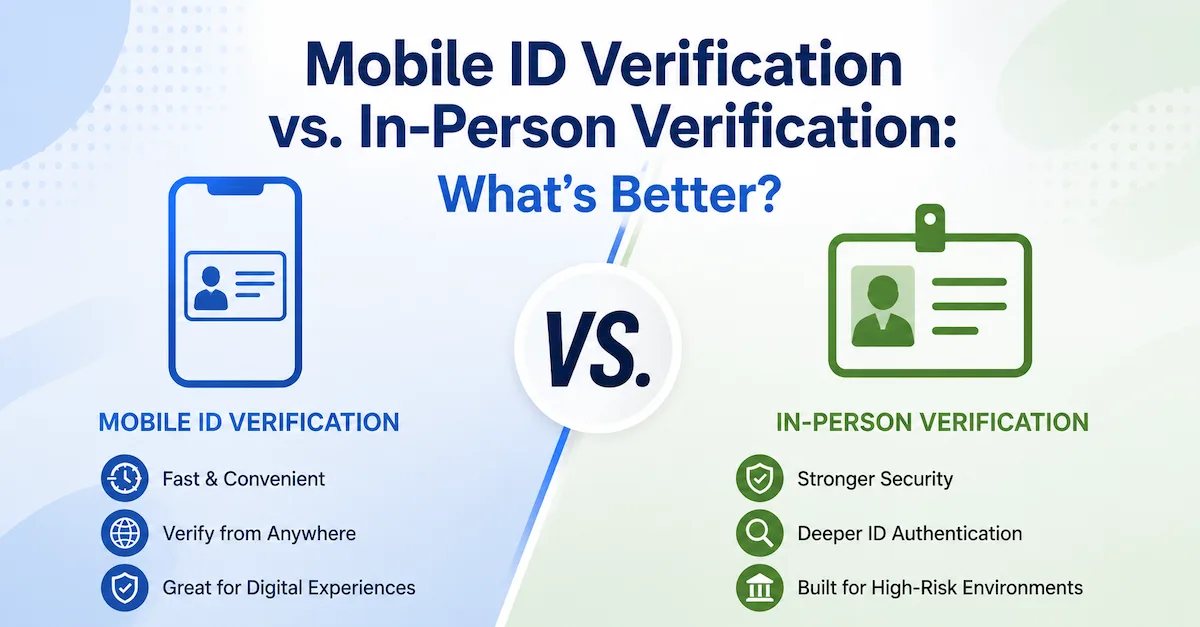

Identity verification has evolved rapidly over the past several years. Businesses are no longer limited to checking IDs at a physical counter or relying solely on manual visual inspection. Today, organizations must decide how to balance remote customer onboarding with secure, high-confidence identity validation. As a result, many companies are comparing remote ID verification with traditional in-person ID verification to determine which approach provides the best combination of fraud prevention, compliance, and customer experience.
The answer depends heavily on the business model, risk level, and operational environment. Remote ID verification offers speed, scalability, and convenience for digital interactions, while in-person ID verification provides deeper physical document authentication and stronger fraud deterrence in high-risk environments. Increasingly, organizations are discovering that the most effective strategy is not choosing one over the other, but combining both into a layered identity verification framework.
What is remote ID verification?
Remote ID verification refers to the process of remotely validating a person’s identity using a smartphone, tablet, or other connected device. In most workflows, a user scans a government-issued ID with their device camera and may also complete biometric verification, such as a selfie match or liveness detection. The process is designed to confirm that both the credential and the person presenting it are legitimate.
Modern remote verification platforms typically include barcode parsing, OCR data extraction, AI-powered document authentication, facial recognition, and third-party identity checks. These tools help businesses automate customer onboarding while reducing manual review processes. Solutions like DIVE support remote identity verification across industries including fintech, banking, logistics, cannabis delivery, online gaming, and eCommerce.
Remote ID verification has become especially valuable for businesses that operate digitally or support remote transactions. Consumers increasingly expect fast, frictionless onboarding experiences that do not require visiting a physical location. Organizations that fail to provide digital identity verification often face lower conversion rates, slower onboarding, and increased operational costs.
What is in-person ID verification?
In-person ID verification occurs when a customer physically presents an identity document to an employee or verification system at a business location. While many people still associate in-person verification with simple visual inspection, modern systems are far more advanced. Today’s ID authentication platforms combine AI-powered software with specialized hardware capable of analyzing both digital and physical document security features.
Advanced in-person verification systems may include barcode validation, front and back OCR crossmatching, UV and infrared analysis, hologram inspection, and visitor management tools. Solutions like VeriScan are designed to help businesses authenticate IDs while also maintaining audit logs, tracking fraud trends, and identifying repeat offenders or banned individuals.
In-person verification remains particularly important in industries with elevated fraud exposure or strict compliance requirements. Casinos, automotive dealerships, logistics providers, financial institutions, and secure facilities often rely on physical authentication hardware because it provides deeper forensic analysis than smartphone camera-based workflows alone.
Benefits of remote ID verification
Faster customer onboarding
One of the biggest advantages of remote ID verification is speed. Customers can verify their identity remotely within seconds instead of visiting a branch, waiting in line, or manually submitting documentation. This creates a significantly more efficient onboarding experience while reducing operational friction for businesses.
For financial institutions, remote identity verification streamlines digital account opening and helps support Know Your Customer (KYC) compliance requirements. Instead of manually entering information from a physical ID, users simply scan their credential and complete verification digitally. This reduces abandonment during onboarding while improving customer satisfaction.
The speed of mobile verification is also beneficial for industries like delivery services, online marketplaces, telehealth, and gig economy platforms where identity checks need to occur quickly and remotely.
Improved customer experience
Consumers increasingly expect digital-first interactions. Requiring customers to appear physically for every verification event can create unnecessary friction, especially for businesses competing on convenience and speed. Remote ID verification allows organizations to provide contactless onboarding and self-service identity checks while minimizing delays caused by manual review.
Remote verification workflows are commonly used for:
- Digital banking
- eCommerce transactions
- Online age verification
- Delivery driver validation
- Remote workforce onboarding
- Telehealth registration
By reducing onboarding complexity, businesses can improve both conversion rates and long-term customer retention.
Better scalability
Remote ID verification is often easier to scale than hardware-based verification systems. Businesses with distributed workforces, national operations, or remote customers can deploy centralized verification workflows without installing dedicated authentication devices at every location.
Cloud-based verification platforms also allow organizations to support remote employees, self-service kiosks, and mobile onboarding experiences from a single system. This operational flexibility has become increasingly important as businesses continue shifting toward hybrid digital and physical workflows.
Support for mobile driver’s licenses and digital IDs
The growth of mobile driver’s licenses (mDLs) and digital identity wallets is further accelerating mobile verification adoption. Businesses increasingly need systems capable of accepting IDs stored digitally on smartphones rather than relying solely on physical cards.
Mobile IDs offer several advantages, including encrypted data transfer, user-controlled information sharing, and reduced physical handling of sensitive documents. IDScan.net supports mobile ID acceptance through solutions compatible with Apple Wallet and ISO-compliant mobile identity standards.
As more states and jurisdictions roll out digital IDs, businesses that support mobile credential acceptance will be better positioned to meet evolving customer expectations.
Challenges of remote ID verification
Limited physical document inspection
Although mobile verification technology has improved significantly, smartphone camera workflows still have limitations compared to forensic authentication hardware. Remote systems primarily rely on barcode validation, OCR analysis, image processing, and AI-based template checks rather than direct physical inspection of the credential itself.
As a result, remote workflows may not fully analyze:
- UV security markings
- Embedded holograms
- Infrared features
- Microprint integrity
- Certain forms of physical tampering
This distinction becomes important in environments where sophisticated fake IDs or altered credentials are common.
Increased exposure to digital fraud
Fraudsters are increasingly targeting remote onboarding systems using synthetic identities, stolen credentials, deepfake selfies, and digitally manipulated documents. As mobile verification adoption grows, attackers continue developing new methods designed to bypass remote authentication controls.
Modern anti-spoofing tools and liveness detection significantly reduce these risks, but remote workflows still face a broader attack surface than tightly controlled in-person environments. Businesses operating in high-risk industries often require additional verification layers to mitigate advanced fraud attempts.
Dependence on camera and image quality
Remote verification accuracy depends heavily on the quality of the user’s device, lighting conditions, camera focus, and internet connectivity. Poor image capture can lead to slower onboarding, increased false rejections, or additional manual review requirements.
Organizations implementing mobile verification must balance strong fraud controls with usability to avoid creating unnecessary friction for legitimate users.
Benefits of in-person verification
Stronger document authentication
In-person verification remains one of the strongest methods for authenticating physical identity documents. Specialized ID scanning hardware can inspect IDs using ultraviolet light, infrared analysis, high-resolution imaging, and hologram validation to identify sophisticated counterfeits or altered credentials.
This deeper level of authentication is especially important for businesses handling:
- High-value transactions
- Casino gaming
- Cargo pickup verification
- Automotive financing
- Secure facility access
- Regulated financial services
Because forensic authentication devices analyze physical security features directly, they often provide stronger protection against advanced fake IDs than camera-only workflows.
Better fraud deterrence
Visible ID authentication systems discourage fraud attempts by increasing the likelihood of detection. Fraudsters are generally less likely to target businesses that actively scan and authenticate IDs compared to organizations relying solely on manual visual inspection.
In-person verification also creates stronger audit trails and reduces employee guesswork. Businesses can track suspicious activity, monitor repeat offenders, and maintain detailed logs that support compliance and incident investigations.
For regulated industries, this operational visibility can play a critical role in demonstrating compliance and reducing liability exposure.
Enhanced operational intelligence
Many in-person verification platforms integrate directly with visitor management and fraud monitoring systems. This allows businesses to identify fraud patterns, flag banned individuals, and analyze operational trends across locations.
Organizations can use scan data to:
- Monitor fraud hotspots
- Track repeat visitors
- Identify suspicious behaviors
- Maintain compliance records
- Improve physical security workflows
These insights help businesses move beyond simple ID checks and develop more proactive fraud prevention strategies.
Challenges of in-person verification
Higher hardware costs
Advanced in-person authentication systems often require dedicated hardware deployments, including ID scanners, forensic authentication devices, and workstation integrations. For organizations operating across multiple locations, these infrastructure costs can become a significant initial investment.
While the added security may justify the investment in high-risk industries, some businesses may find mobile-first workflows more cost-effective for lower-risk use cases.
Reduced customer convenience
Requiring customers to appear physically for verification can slow onboarding and create additional friction. This is particularly problematic for digital-first businesses where speed and convenience directly impact customer acquisition and retention.
In industries like fintech, eCommerce, and delivery services, requiring in-person verification for every interaction may negatively affect conversion rates and customer satisfaction.
Less flexibility for remote operations
In-person verification workflows are inherently less flexible for businesses operating remotely or nationally. Organizations supporting remote employees, mobile workforces, or geographically distributed customers often require digital verification tools to scale efficiently.
For this reason, many businesses are shifting toward hybrid verification models that combine remote onboarding with selective in-person authentication when needed.
Which ID verification method is better?
There is no universal answer to whether mobile or in-person verification is better. The ideal approach depends on fraud risk, regulatory requirements, transaction value, and customer expectations.
For many organizations, the strongest fraud prevention strategy combines both methods into a layered identity verification framework.
Why hybrid identity verification is becoming the standard
Businesses increasingly recognize that remote and in-person verification are not competing technologies. Instead, they are complementary tools that serve different purposes within the customer journey.
A logistics company may remotely verify a driver before arrival and then authenticate the physical CDL at pickup. A bank may digitally onboard a customer while requiring enhanced in-person verification for high-risk transactions. A retailer may accept mobile IDs while maintaining forensic authentication hardware for suspicious cases.
Hybrid verification models allow businesses to combine convenience with deeper security controls. Platforms like VeriScan support syncing remote identity checks with in-person authentication activity to create unified fraud prevention workflows across digital and physical environments.
This layered approach helps organizations:
- Reduce fraud exposure
- Improve customer experiences
- Strengthen compliance
- Increase operational flexibility
- Scale verification workflows more effectively
The future of identity verification
The future of identity verification is not fully remote or fully in-person. Instead, the industry is moving toward adaptive identity ecosystems capable of supporting both physical and digital credential validation.
As AI-driven fraud tactics continue evolving and mobile IDs become more common, businesses will increasingly need flexible platforms capable of:
- Verifying identities remotely
- Authenticating physical documents
- Accepting digital IDs
- Detecting advanced fraud attempts
- Supporting compliance initiatives
- Delivering seamless user experiences
Organizations that invest in layered identity verification strategies will be better positioned to reduce fraud while meeting growing customer expectations for speed, convenience, and security.