Skip to content


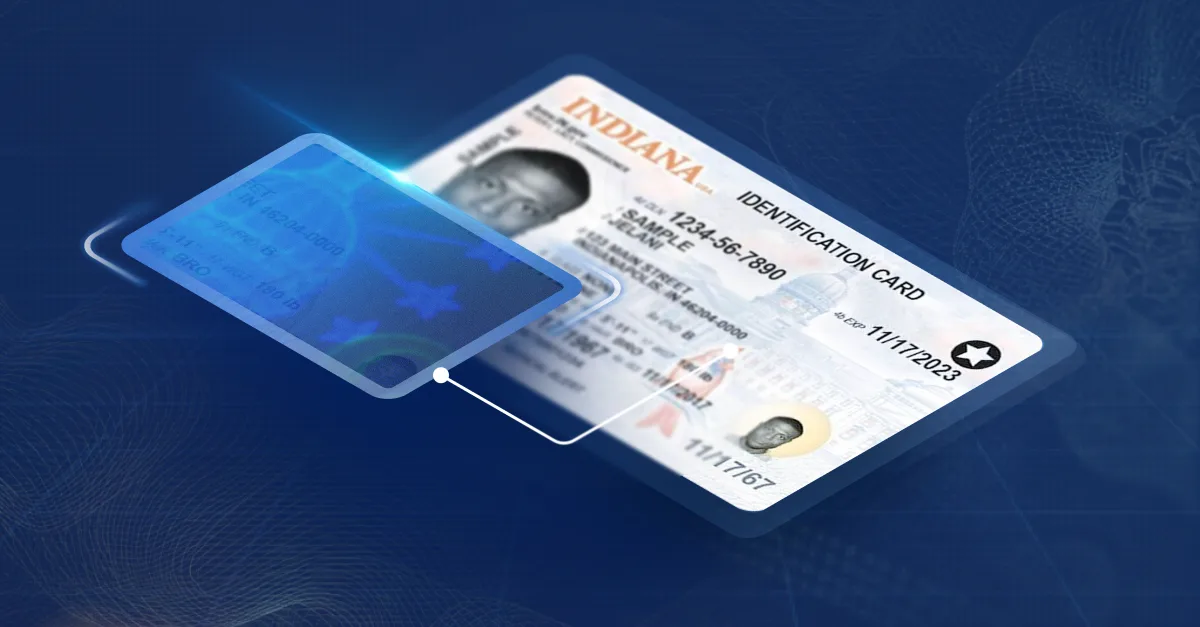

Ultraviolet (UV) markings are one of the most widely used security features on modern identity documents. Driver’s licenses, state-issued identification cards, passports, visas, and other secure credentials can contain images, patterns, text, fibers, or other elements that are difficult or impossible to see under normal lighting but become visible when the document is exposed to ultraviolet light.
For businesses that rely on identity documents to verify age, identity, or eligibility, UV features can provide an additional layer of evidence that an ID is genuine. However, UV markings are only one component of modern document security. Understanding how they work, and how they can be evaluated alongside other security features, is important for building a more reliable ID verification process.
What are ultraviolet markings on IDs?
Ultraviolet (UV) markings are security features designed to react when exposed to specific wavelengths of UV light. Under ordinary visible light, some UV features may be completely invisible. When illuminated by an appropriate UV source, like an authentication capable ID scanner, fluorescent inks, fibers, patterns, symbols, or other features can become visible.
This makes UV markings a type of covert or semi-covert security feature. Unlike information such as a name, date of birth, photograph, or expiration date, UV features generally are not intended to be obvious during everyday use of the document.
AAMVA, which develops standards and best practices for driver’s licenses and identification cards in North America, distinguishes between overt security features that can be examined without equipment and Level 2 features that require tools such as magnification, specialized lighting, or ultraviolet lighting.
UV security features are also used internationally. The International Civil Aviation Organization (ICAO), which establishes standards for machine-readable travel documents, specifically addresses UV-responsive materials and fluorescent features in its specifications for passports and other travel documents.
How do UV security features work?
UV security features rely primarily on fluorescence. Certain inks, pigments, fibers, and materials absorb ultraviolet radiation and emit visible light in response. As a result, an element that appears invisible or extremely faint in normal lighting can suddenly appear brightly colored when illuminated with UV light.
A document might therefore look relatively ordinary to the naked eye while displaying an entirely different layer of artwork under UV illumination.
Depending on the issuing authority and document design, UV illumination may reveal elements such as:
- State or national seals
- Geographic outlines
- Repeating patterns
- Symbols or emblems
- Fine lines and security artwork
- Text or abbreviations
- Fluorescent fibers embedded in the document
- Portions of the holder’s photograph or other personalized elements
The exact design, placement, color, and behavior of these features vary substantially between jurisdictions and document formats. That variation is important because effective ID authentication requires knowing what should be present on the particular document being examined, not simply checking whether something glows.
Why are UV markings used on IDs?
UV markings add another obstacle for someone attempting to counterfeit an identity document.
A basic counterfeit may reproduce the information that is readily visible on an ID, including its colors, portrait, text, background graphics, and even a barcode. Reproducing the complete optical behavior of a genuine credential is considerably more complicated.
A counterfeiter would need to know that a UV feature exists, understand what it is supposed to look like, determine its precise location and appearance, and reproduce it using materials with the appropriate fluorescent properties.
This is one reason secure documents rely on layered security rather than a single feature.
AAMVA’s security guidance recognizes combinations of different levels of document security as important for counterfeit deterrence. ICAO similarly recommends combinations of security materials, printing techniques, and other measures to protect travel documents against unauthorized reproduction, alteration, and tampering.
What do IDs look like under UV light?
There is no universal UV appearance for an identity document.
One driver’s license might reveal a large state-specific image across the card. Another could display repeating fluorescent symbols or fine-line patterns. A passport may contain fluorescent fibers, page designs, national symbols, or other artwork distributed across its pages.
These designs can also change when jurisdictions introduce new ID formats. A UV pattern that is correct for one generation of a driver’s license may not necessarily be correct for an older or newer version issued by the same jurisdiction.
That is why simply teaching employees to “look for a UV mark” has limitations. Effective inspection requires knowing what UV feature should appear on that specific document version.
What type of UV light is used to check IDs?
UV light encompasses a range of wavelengths, and security features may respond differently depending on the illumination used.
For automated travel-document authentication, ICAO specifies 365 nm UV illumination for capturing UV images used in optical document checks. ICAO notes that some passport readers also support shorter wavelengths, including 254 nm and 313 nm, although these technologies are less widespread.
For businesses, this distinction matters because using an inappropriate light source can lead to misleading results. A security feature may appear weak, look different than expected, or fail to become visible if it is examined under the wrong conditions.
Can fake IDs have UV markings?
Yes. The presence of UV fluorescence alone does not prove that an ID is genuine.
Sophisticated counterfeiters may attempt to reproduce UV patterns or add fluorescent inks to fake IDs. A counterfeit document may therefore display something under UV light while still failing to reproduce the correct security feature.
The more useful questions are whether the expected feature is present and whether its design, position, shape, color, intensity, and interaction with the rest of the document are consistent with a genuine credential.
A fake ID might contain a fluorescent state outline, for example, but the outline could be positioned incorrectly. Another counterfeit might reproduce the general UV design but use ink that fluoresces differently from the genuine credential. Some counterfeits may also cause areas of the document to fluoresce that should remain UV dull.
For this reason, UV inspection is much more powerful when combined with additional authentication checks.
UV markings vs. other ID security features
Modern identity documents typically use multiple security technologies at the same time. UV markings may be combined with holographic or optically variable elements, microprinting, laser engraving, tactile features, fine-line printing, transparent windows, lenticular printing, ghost images, variable laser images, micro-perforations, and other document-specific features.
Each provides a different authentication signal.
A barcode, for example, primarily provides machine-readable data. A holographic feature can provide an overt visual security check. Microprinting requires closer inspection or magnification. UV artwork provides another optical layer that generally requires specialized illumination.
Together, these features make a convincing counterfeit significantly more difficult to manufacture.
Why barcode scanning alone cannot authenticate an ID
One of the most important distinctions for businesses is the difference between ID parsing and ID authentication.
Reading the PDF417 barcode on the back of a driver’s license can quickly extract information such as name, date of birth, expiration date, address, and document number. This is useful for age verification, data entry, visitor management, and many other workflows.
But a barcode can potentially be copied, modified, or generated.
A basic barcode scan therefore does not automatically confirm that the physical credential itself is genuine. ID authentication requires examining security characteristics of the document in addition to reading its encoded data.
UV analysis is one example of the additional checks that can contribute to physical document authentication.
How automated ID authentication uses UV light
Advanced ID authentication systems, like VeriScan Identity Platform, can take UV inspection beyond a manual visual check.
Instead of an employee holding an ID beneath a UV lamp and deciding whether it “looks right,” compatible ID authentication scanners can capture images of the credential under multiple illumination conditions.
Depending on the scanner and document, these can include visible light, ultraviolet light, infrared light, and other specialized illumination.
ID authentication software can then compare characteristics captured from the presented document against expected characteristics for that document type.
This approach can make UV inspection more consistent because authentication does not depend entirely on an employee remembering the UV design of potentially hundreds or thousands of ID formats.
Why UV authentication matters for businesses
Businesses in age-restricted retail, hospitality, gaming, financial services, automotive, logistics, security, and other industries frequently rely on government-issued identification.
In many of these environments, employees are expected to make identity decisions quickly. At the same time, counterfeit IDs continue to become more sophisticated.
Visual inspection remains valuable, but employees may not know the security characteristics of every driver’s license, passport, or international identity document they encounter. Even within the United States, jurisdictions periodically redesign their credentials, creating multiple legitimate versions that may remain in circulation simultaneously.
Technology capable of evaluating document security features can help businesses create a more consistent ID verification process.
UV markings are one piece of the ID security puzzle
Ultraviolet markings are effective because they add an additional layer of information that is largely hidden during normal use. Fluorescent inks, UV-dull substrates, security fibers, and document-specific artwork can all make identity documents more difficult to reproduce accurately.
But UV fluorescence should never be treated as a standalone guarantee of authenticity.
Modern identity documents are intentionally designed with multiple layers of security. The strongest authentication workflows evaluate several of these characteristics together, including visible document design, encoded information, UV and infrared responses, and other physical security features.
For businesses, understanding UV markings is therefore less about memorizing what every ID should look like beneath a black light and more about understanding the principle behind layered document authentication: a genuine identity document should behave correctly across multiple types of inspection.
As counterfeit IDs become more sophisticated, evaluating those layers together can help businesses make more informed identity decisions and identify fraudulent documents that might otherwise pass a basic visual or barcode check.