Skip to content


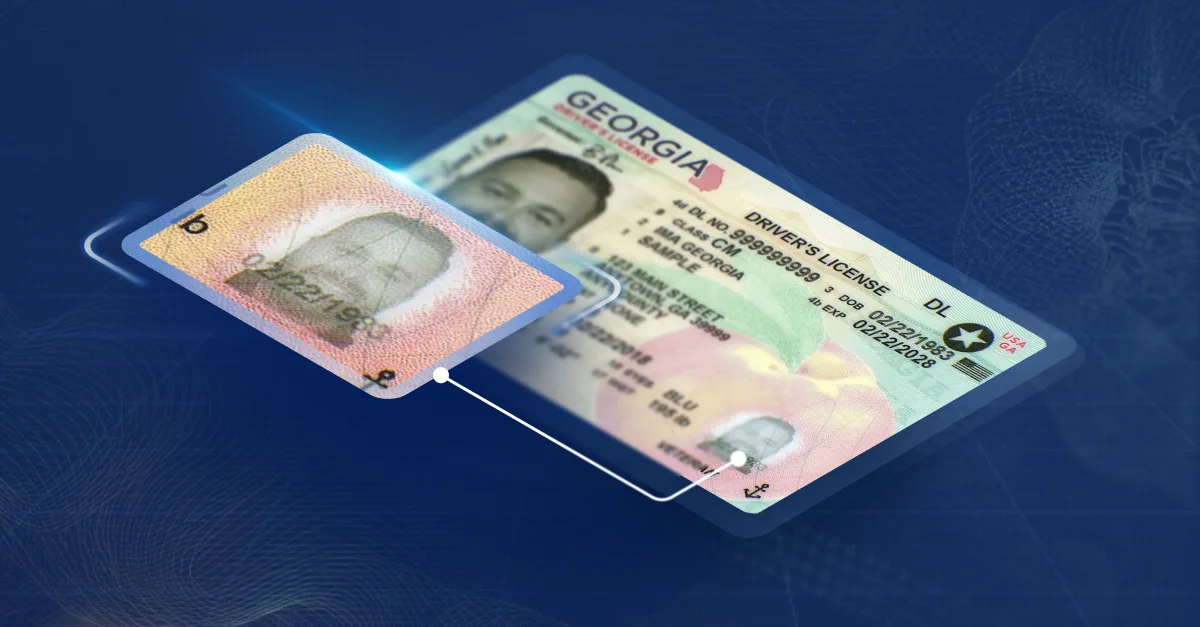

Some of the most advanced security features on modern driver’s licenses are easy to miss until the card is tilted.
Lenticular printing and related multiple-image or changeable-image technologies allow an ID to display different information depending on the angle from which the credential is viewed. An image may appear to move, a portrait may switch to another image, or information may become visible only when the card is held at a particular angle.
These effects aren’t decorative. They are advanced document security features designed to make driver’s licenses and identification cards substantially more difficult to counterfeit.
As states increasingly transition toward polycarbonate and laser-engraved credentials, lenticular and optically variable technologies are becoming an important part of modern ID security.
What is lenticular printing?
Lenticular printing uses a series of extremely small lenses to create images that change depending on viewing angle.
The basic concept is familiar from novelty cards or images that appear to move when tilted. On secure identity documents, however, similar technology can be manufactured at much greater precision and incorporated into the credential itself.
A lenticular security feature can be designed so that two or more images become visible at different angles. On an ID, this might involve a secondary portrait, date of birth, state symbol, or other personalized or document-specific information.
Because the effect relies on specialized optical construction rather than ordinary ink, it is considerably more difficult to reproduce using conventional printers.
Why are lenticular features used on IDs?
A fake ID manufacturer can attempt to copy the visible artwork on a driver’s license. Reproducing a dynamic optical effect embedded within a secure credential is much harder.
Lenticular features provide issuing authorities with an additional overt security layer that can be inspected without accessing a government database.
When the ID is tilted, the expected image should appear, disappear, or change in a predictable way. If the feature is absent, static, improperly positioned, or displays incorrect information, the credential may warrant additional scrutiny.
These features are particularly effective when incorporated into polycarbonate IDs because personalization and security elements can be created within the structure of the card instead of simply being printed onto its surface.
Lenticular printing vs. holograms
Lenticular effects and holograms are both optically variable security technologies, but they achieve their effects differently.
A hologram generally uses the interaction between light and a specially manufactured optical structure to create reflective, color-changing, or shifting imagery. It may display a state seal, logo, repeating text, landmark, or other security pattern as the credential is tilted.
Lenticular technology uses lenses or related optical structures to display different images at different viewing angles. Rather than simply changing reflectivity or color, the credential can appear to switch between distinct pieces of information.
To someone checking an ID, both technologies involve tilting the credential. What the inspector should expect to see, however, depends on the document format.
Lenticular features on Ohio driver’s licenses
Ohio provides a prominent U.S. example of this type of document security.
Ohio’s modern polycarbonate driver’s license incorporates advanced laser engraving and an optical security feature capable of displaying a secondary image depending on the viewing angle.
The feature is integrated into the credential as part of its security architecture rather than simply being printed onto the card’s surface. This makes it much more difficult for counterfeiters to reproduce accurately.
It also demonstrates why the transition toward polycarbonate IDs is significant for fraud prevention.
Lenticular and changeable laser images
Not every angle-dependent image on a driver’s license is technically produced using traditional lenticular printing.
Modern ID documents can use several technologies to create changeable or multiple-image effects. One increasingly important category is the Changeable Laser Image, commonly abbreviated CLI, or Multiple Laser Image, known as MLI.
These features can display different pieces of laser-engraved information depending on viewing angle.
For example, tilting an ID might alternate between a secondary portrait and the cardholder’s date of birth. Because the information can be personalized to the individual credential, reproducing the feature becomes substantially more difficult than copying a generic state seal or background design.
Polycarbonate IDs and lenticular security
The growing adoption of polycarbonate driver’s licenses is helping states incorporate increasingly sophisticated optical security features.
Traditional PVC credentials are generally constructed from multiple layers and rely heavily on printing, laminates, overlays, and other applied security elements.
Polycarbonate credentials are manufactured differently. Layers of polycarbonate are fused together into a solid structure, and personal information can be laser engraved within the card.
This makes it possible to incorporate security features that are closely tied to the cardholder’s personalized data while making physical alteration considerably more difficult.
Lenticular lenses, multiple laser images, transparent windows, tactile engraving, and related optical features can therefore become part of a larger integrated security system.
Can fake IDs replicate lenticular features?
Counterfeiters can attempt to simulate nearly any visible security feature, but reproducing sophisticated optical effects accurately is considerably more difficult than copying printed artwork.
A counterfeit ID may attempt to imitate a lenticular effect using printed imagery, reflective materials, inexpensive lens films, or other techniques.
The result may look convincing from one angle but fail when the card is rotated. The image may not switch correctly, may appear blurry, may lack depth, or may not display the personalized information expected on the authentic credential.
As fake ID manufacturing becomes more sophisticated, however, businesses should avoid relying on the absence or presence of any single security feature to determine authenticity.
How to check lenticular features on an ID
The simplest manual inspection involves slowly tilting the ID under good lighting and observing whether the expected optical change occurs.
The feature should behave consistently as the viewing angle changes. If the legitimate format contains a secondary portrait, for example, that portrait should appear in the correct location and at the expected angle.
Inspectors should also compare the feature with the rest of the credential. A sophisticated optical effect does not compensate for incorrect fonts, inaccurate card construction, mismatched information, an anomalous barcode, or missing security elements elsewhere on the ID.
The challenge is that employees must know which security feature belongs to which ID format. With more than 50 U.S. issuing jurisdictions and periodic redesigns, memorizing every current and historical security feature is unrealistic for most businesses.
Can ID scanners detect lenticular security features?
The capabilities of an ID scanner depend heavily on the hardware and software being used.
Basic barcode scanners primarily read information encoded in the PDF417 barcode on the back of most U.S. driver’s licenses. They cannot comprehensively evaluate the physical construction of the document simply by reading its barcode.
Authentication-capable ID scanners perform a much deeper analysis.
Depending on the scanner and document, ID authentication workflows can capture high-resolution images and analyze the credential under white, ultraviolet, and infrared illumination. Software, like VeriScan Identity Platform, can then compare the resulting images and document features against templates for legitimate credentials.
This allows authentication technology to evaluate the physical ID alongside its encoded data instead of assuming that a successfully scanned barcode means the document is authentic.
Why lenticular security matters for businesses
Businesses rarely need to know the technical manufacturing process behind every driver’s license they encounter. They do, however, need confidence that the document being presented is legitimate.
This is particularly important in industries where an identity decision determines whether someone can enter a facility, open an account, rent a vehicle, purchase an age-restricted product, or complete another high-risk transaction.
Lenticular and other optically variable security features add another barrier against counterfeit documents. They also give businesses another characteristic that can be evaluated when an ID appears suspicious.
But these features work best as part of a layered ID verification process.
How IDScan.net helps authenticate IDs
IDScan.net’s ID authentication technology is designed to evaluate physical identity documents using hundreds of algorithmic checks.
When paired with authentication-capable hardware, the platform can analyze high-resolution document imagery alongside ultraviolet and infrared features, barcode data, OCR results, holograms, watermarks, microprint, and other document-specific characteristics.
The goal is not simply to determine whether a credential contains one particular security feature. Instead, ID authentication determines whether the document as a whole behaves and appears as expected for that jurisdiction and ID format.
This approach becomes increasingly valuable as states adopt more complex polycarbonate credentials containing security elements that are difficult for employees to evaluate manually.
Are lenticular features enough to catch a fake ID?
Lenticular security can make an ID much harder to counterfeit, but no individual security feature is foolproof.
Businesses should think of ID security as a collection of overlapping layers. A modern credential might contain laser engraving, a lenticular or changeable image, microprint, ultraviolet imagery, tactile features, barcode security elements, and other covert or overt protections.
A counterfeit document has to reproduce enough of those layers convincingly to pass inspection.
The more layers that are evaluated, the more opportunities there are to identify inconsistencies.
The future of lenticular features on U.S. IDs
The distinction between traditional lenticular printing and newer optically variable technologies will likely become increasingly important as U.S. driver’s licenses evolve.
States are continuing to modernize credentials with polycarbonate construction, laser personalization, transparent elements, optically variable imagery, and other sophisticated anti-counterfeit features.
For consumers, many of these technologies will simply look like an image that changes when the card is tilted. Behind that simple visual effect, however, is sophisticated document engineering designed to make the credential more difficult to copy or alter.
For businesses, this evolution also makes automated authentication increasingly useful. As physical IDs become more complex, checking the entire credential against the expected document format can provide significantly more information than simply reading the barcode on the back.