Skip to content


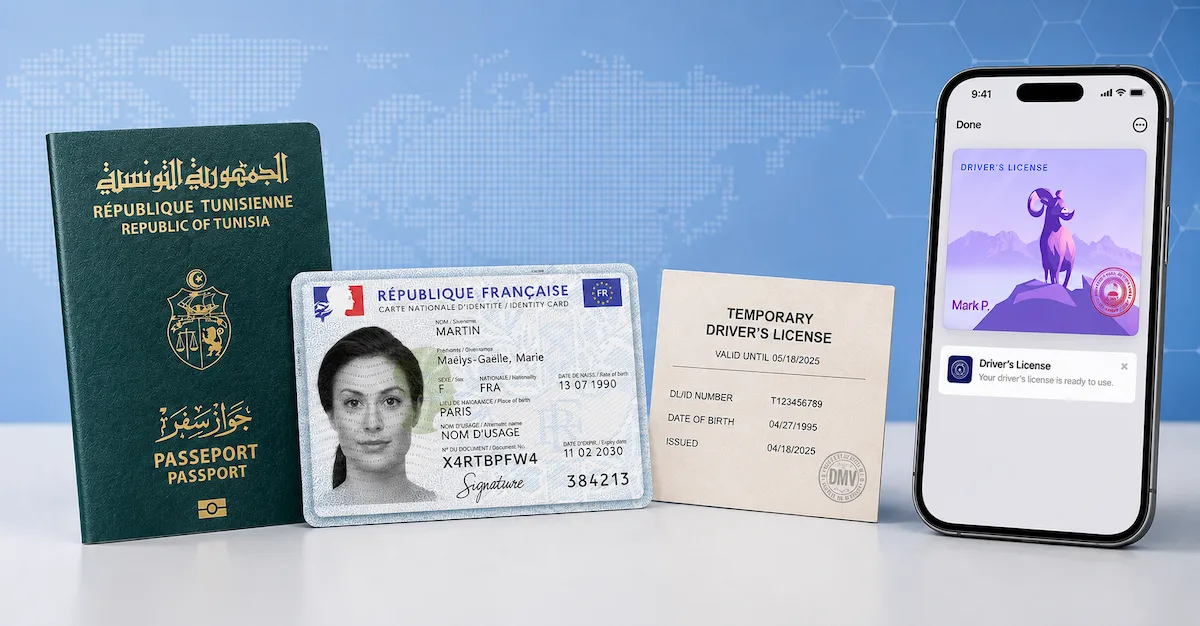

For many businesses, identity verification is designed around a familiar scenario: a customer presents a standard driver’s license issued by the state where the transaction takes place. In reality, identity verification is rarely that straightforward. Every day, businesses encounter customers using foreign passports, international driver’s licenses, temporary paper credentials, and increasingly, digital IDs stored on smartphones.
These documents are often treated as “edge cases,” but they are becoming increasingly common across industries. Hotels welcome international travelers, financial institutions onboard foreign nationals and temporary residents, automotive dealerships process customers waiting for permanent licenses to arrive, and retailers are beginning to see mobile driver’s licenses used for age verification and identity checks. As governments continue modernizing identity credentials and digital identity adoption grows, businesses should expect these scenarios to become part of everyday operations rather than rare exceptions.
Unfortunately, these documents can also introduce uncertainty. Employees may be unfamiliar with an overseas driver’s license, unsure whether a temporary paper ID is legitimate, or uncertain how to handle a customer presenting a mobile driver’s license instead of a physical card. Without clear procedures or the right technology, these situations can slow transactions, frustrate legitimate customers, and create opportunities for fraud.
The goal isn’t for employees to become experts on every identity document issued around the world. Instead, businesses need identity verification processes that are flexible enough to handle a wide variety of credentials while remaining fast, accurate, and consistent. Modern ID scanning technology helps bridge that gap by recognizing different document types, extracting standardized information, and supporting both traditional and emerging forms of identification.
Why edge cases matter for businesses
Every identity verification workflow is built around consistency. Employees are trained to recognize familiar credentials, systems are configured to process common document types, and policies are written with standard driver’s licenses in mind. When an unfamiliar document is presented, that consistency can quickly break down.
A customer presenting a passport instead of a driver’s license, a temporary paper credential after renewing their license, or a mobile ID stored in a digital wallet can create hesitation even when the document is completely legitimate. Employees may spend additional time inspecting the credential, asking for secondary identification, or seeking assistance from a manager. While these delays may seem minor on an individual transaction, they can add up quickly across high-volume businesses, affecting customer satisfaction and operational efficiency.
The challenge extends beyond customer experience. Fraudsters often take advantage of unfamiliarity. When employees rarely encounter certain document types, they are less likely to recognize suspicious formatting, missing security features, or altered information. Conversely, legitimate customers may be incorrectly turned away simply because the document they present falls outside of what employees see every day.
Rather than creating separate procedures for every possible credential, businesses benefit from a verification process that treats all supported identity documents consistently. Whether someone presents a driver’s license from another country, a temporary license issued last week, or a digital ID stored on their phone, the goal should be the same: verify the credential quickly, accurately, and with confidence.
| Common Edge Case | Why It Creates Challenges |
| Foreign IDs | Different languages, layouts, date formats, and security features can make manual verification difficult. |
| Temporary IDs | Paper credentials often lack the security features and machine-readable elements found on permanent IDs. |
| Digital IDs | New verification methods, varying state adoption, and evolving technology require updated business workflows. |
Foreign IDs
International customers are no longer the exception
Businesses today serve a far more global customer base than they did even a decade ago. Whether it’s a hotel checking in international travelers, a bank opening accounts for foreign students, a car rental agency serving tourists, or a retailer verifying age for overseas visitors, encountering identity documents issued outside the United States has become increasingly routine.
Unlike U.S. driver’s licenses, however, there is no single standard for how foreign identity documents are designed. Every country, and in many cases each province or region, uses its own layouts, languages, numbering systems, security features, and machine-readable technologies. Even something as simple as locating a customer’s date of birth or expiration date can become challenging when a document is written in another language or follows a completely different format.
For businesses that rely solely on manual inspection, this creates an impossible expectation. Employees cannot realistically be expected to recognize thousands of legitimate identity document designs from around the world or remember the unique characteristics of each one. As international travel, migration, and global commerce continue to increase, organizations need verification processes that can confidently handle unfamiliar credentials without placing that burden on frontline staff.
Modern identity verification technology helps solve this challenge by identifying supported document types, extracting standardized information, and presenting it in a consistent format for employees. Rather than asking staff to become experts on foreign credentials, businesses can rely on technology to simplify verification while improving both efficiency and customer experience.
Not all foreign IDs are created equal
When people think of foreign identity documents, they often picture passports. While passports are among the most recognizable international credentials, they represent only a small portion of the documents businesses may encounter. Depending on the industry, customers may present foreign driver’s licenses, national identity cards, residence permits, border crossing cards, or other government-issued credentials.
Each document is designed to meet the issuing country’s own standards, meaning there is no universal layout or formatting. Some countries prioritize machine-readable barcodes, while others rely primarily on printed information and security features. Certain national ID cards closely resemble a U.S. driver’s license, while others contain multiple languages, unique numbering systems, or entirely different visual designs. For businesses that verify identities regularly, this diversity can make manual inspection both time-consuming and inconsistent.
The challenge is compounded by the fact that governments continually update their credentials. Countries introduce new security features, redesign card layouts, and transition to more durable materials on a regular basis. A document issued today may look very different from one issued just a few years ago, even though both remain valid. Businesses need verification processes that can adapt to these changes without requiring constant employee retraining.
Language and formatting differences
One of the biggest challenges with foreign IDs is simply locating and interpreting the information needed to complete a transaction. While the data itself, such as a person’s name, date of birth, or document expiration date, is generally consistent across identity documents, how that information is presented can vary significantly.
Many credentials are printed in multiple languages, while others use scripts that may be unfamiliar to employees. Documents may include accented characters, non-Latin alphabets, or transliterated names that appear differently than they do in official records. Even date formats differ around the world, creating opportunities for simple but significant mistakes during manual verification.
For example, a date displayed as 03/07/2026 could be interpreted as either March 7 or July 3 depending on the issuing country’s convention. Without familiarity with that country’s formatting standards, an employee could easily misread a customer’s age or the document’s expiration date.
| Country/Region | Common Date Format | Example |
| United States | MM/DD/YYYY | 07/03/2026 |
| Canada | YYYY-MM-DD or DD/MM/YYYY | 2026-07-03 |
| United Kingdom | DD/MM/YYYY | 03/07/2026 |
| Germany | DD.MM.YYYY | 03.07.2026 |
| Japan | YYYY/MM/DD | 2026/07/03 |
These differences may seem minor, but they can have real operational consequences. A misinterpreted birth date could lead to an incorrect age verification decision, while confusion over an expiration date could delay customer onboarding or result in unnecessary requests for additional identification.
Security features vary around the world
Visual security features also differ significantly between countries. While many governments use holograms, optically variable inks, laser engraving, ghost portraits, ultraviolet features, or microprinting, there is no standardized combination of security elements that applies to every credential.
As a result, employees who are trained to recognize the security features of local driver’s licenses may not know what to expect on an unfamiliar international document. That uncertainty can make it difficult to distinguish between a legitimate credential and one that has been altered or counterfeit through visual inspection alone.
This is particularly important for businesses in industries where fraud carries significant financial or regulatory consequences, such as financial services, logistics, hospitality, automotive, gaming, and age-restricted retail.
How ID scanning simplifies foreign ID verification
Modern ID scanning platforms are designed to reduce the complexity of verifying international credentials by automatically recognizing supported document types and extracting the information businesses need. Rather than asking employees to locate data fields manually, the software presents standardized information that can be quickly reviewed or integrated into existing systems.
Depending on the document type, modern identity verification solutions can leverage multiple technologies to improve accuracy. OCR can capture printed information from the face of the document, barcode decoding can extract structured data where supported, and Machine Readable Zone (MRZ) reading enables fast, standardized processing of passports and many international travel documents. Some solutions, like VeriScan Identity Platform, also support RFID reading for compatible electronic passports, allowing businesses to access securely stored chip data when appropriate hardware is available.
Beyond simply capturing data, these technologies help normalize differences between document formats. Regardless of how an issuing authority structures its credential, businesses receive information in a consistent format that reduces manual data entry, minimizes interpretation errors, and creates a more efficient verification workflow.
Temporary IDs
Why temporary IDs exist
Not every customer has a permanent driver’s license or identification card in hand. Every day, motor vehicle agencies issue temporary credentials while a permanent card is being produced, mailed, or replaced. For businesses that rely on identity verification, these documents are a routine part of doing business, even if they are encountered less frequently than standard plastic IDs.
A temporary ID may be issued for a variety of reasons. Someone renewing their driver’s license may receive a paper credential while waiting for the new card to arrive in the mail. A customer who has recently changed their name or address may be issued a temporary replacement. New drivers, individuals upgrading to a REAL ID, or someone replacing a lost or stolen license may also receive an interim credential before their permanent identification is printed.
Because these documents are intended to bridge the gap between issuance and delivery of a permanent credential, they are often valid for only a short period of time. However, during that validity window, they serve as a legitimate government-issued form of identification and should be treated accordingly.
Why temporary IDs are challenging to verify
Unlike permanent driver’s licenses, temporary IDs are not standardized across jurisdictions. Every state, and many international jurisdictions, has its own approach to designing interim credentials. Some resemble official government forms, while others are little more than a printed sheet of paper containing the customer’s information.
Many temporary IDs also lack the features businesses have come to rely on when verifying identity. A permanent driver’s license typically includes durable construction, embedded security features, and a machine-readable barcode. Temporary credentials may not.
Common characteristics of temporary IDs include:
- Printed on standard paper rather than polycarbonate or PVC
- Limited or no visual security features
- May not include a barcode or magnetic stripe
- Can vary significantly in appearance between jurisdictions
- Often have shorter validity periods than permanent credentials
These differences don’t necessarily make a temporary ID less legitimate, they simply make it more difficult to verify using traditional methods.
Fraud risks and operational challenges
Temporary IDs occupy an unusual space in identity verification. Because they often contain fewer security features than permanent credentials, they can be easier for fraudsters to alter or reproduce. At the same time, many employees encounter temporary IDs infrequently, making it difficult to distinguish between a legitimate document and one that has been manipulated.
This uncertainty can create problems on both sides of the transaction. Employees may spend additional time reviewing the document, escalating the verification to a manager, or requesting secondary identification. In some cases, legitimate customers are turned away simply because staff are unfamiliar with the format being presented. In others, a fraudulent document may be accepted because employees lack the tools or experience needed to identify inconsistencies.
For businesses operating across multiple locations, inconsistent handling of temporary IDs can also lead to uneven customer experiences. One location may readily accept a valid interim credential, while another may reject the same document despite it meeting the issuing authority’s requirements. Establishing consistent ID verification procedures is essential to reducing both fraud risk and customer frustration.
Temporary IDs are constantly changing
Adding to the challenge is the fact that temporary IDs are rarely static. Departments of Motor Vehicles routinely update their forms, redesign document layouts, introduce new security features, or modify the information included on interim credentials. These changes often accompany larger driver’s license redesigns or technology upgrades.
For businesses, this means that employee training alone is rarely enough. Even staff who are familiar with one version of a state’s temporary ID may struggle when a new design is introduced. Organizations need ID verification processes that can adapt as document formats evolve rather than relying solely on institutional knowledge.
How ID scanning helps verify temporary IDs
While temporary IDs may not always include machine-readable barcodes, modern identity verification technology can still streamline the verification process. Rather than relying exclusively on barcode decoding, many ID scanning solutions use optical character recognition (OCR) and document recognition to capture information directly from the printed credential.
By extracting key fields such as the customer’s name, date of birth, document number, issuing jurisdiction, and expiration date, OCR helps businesses reduce manual data entry while creating a more consistent ID verification workflow. Even when a barcode is unavailable, businesses can still electronically capture and review the information needed to complete a transaction.
Some temporary credentials do include barcodes that can be decoded just like a permanent driver’s license, allowing businesses to use the same identity verification workflow regardless of whether the customer presents a temporary or permanent document. When a barcode is unavailable, OCR provides an effective alternative, ensuring businesses can continue processing legitimate customers without unnecessary delays.
Rather than forcing employees to make subjective decisions based solely on appearance, modern identity verification platforms help standardize the handling of temporary credentials. This not only improves operational efficiency but also reduces the likelihood of legitimate customers being inconvenienced simply because they have not yet received their permanent ID.
Digital IDs
Digital identity is moving into the mainstream
For decades, identity verification has revolved around physical credentials. Whether checking into a hotel, purchasing age-restricted products, opening a bank account, or renting a vehicle, customers have traditionally presented a plastic driver’s license or identification card. Today, however, that model is beginning to change.
Governments around the world are investing in digital identity initiatives that allow individuals to securely store government-issued credentials on their smartphones. In the United States, a growing number of states have launched mobile driver’s license (mDL) programs, while countries in Europe and elsewhere are developing digital identity wallets that can be used across both public and private services.
Although adoption is still in its early stages, digital IDs are becoming increasingly common. Businesses that understand how these credentials work, and how to verify them, will be better prepared as consumer adoption continues to accelerate.
Digital IDs are more than a photo of a driver’s license
One of the biggest misconceptions about digital IDs is that they are simply digital copies or photographs of a physical driver’s license. In reality, legitimate digital IDs are designed with security and privacy at their core.
Rather than displaying a static image that could potentially be copied or altered, properly implemented digital IDs use cryptographic protections to verify that the credential was issued by the appropriate government authority and that the information being shared has not been modified. This creates a much higher level of trust than simply viewing a photo stored on a smartphone.
Many digital IDs also support selective disclosure, allowing users to share only the information required for a particular transaction. For example, a retailer performing an age verification check may only need confirmation that a customer is over 21, not their full address, driver’s license number, or other personal information. This privacy-focused approach benefits both consumers and businesses by limiting unnecessary data exposure.
A growing digital identity ecosystem
While the United States has primarily focused on state-issued mobile driver’s licenses, the broader digital identity landscape continues to expand. Apple Wallet, Google Wallet, and Samsung Wallet all support compatible digital credentials in select jurisdictions, giving consumers multiple ways to securely carry government-issued identification on their mobile devices.
At the same time, governments are working toward greater interoperability through standards such as ISO/IEC 18013-5, which establishes specifications for mobile driver’s licenses and how they can be securely presented and verified. Standardization is an important step toward ensuring that businesses can confidently accept digital IDs regardless of where they were issued or which compatible wallet stores them.
Although implementation varies by jurisdiction, the long-term trend is clear: digital identity is becoming an increasingly important part of modern identity verification.
Why digital IDs present new challenges for businesses
Despite their advantages, digital IDs introduce new operational considerations. Unlike physical driver’s licenses, which have been widely accepted for decades, digital identity programs are still expanding, and implementation varies between jurisdictions. Businesses must determine which digital credentials they can accept, whether their existing ID scanning hardware supports digital ID verification, and how employees should handle customers who choose to present a mobile ID instead of a physical card.
Employee training also becomes increasingly important. Staff should understand the difference between a legitimate mobile driver’s license presented through an approved digital wallet and a simple photograph or screenshot of a physical ID. While the latter provides little assurance of authenticity, properly verified digital IDs are designed to establish trust through secure communication with the issuing authority’s credential.
Businesses also need to consider how digital IDs fit into existing workflows. Whether verifying age, onboarding new customers, or confirming identity at check-in, the verification process should remain consistent regardless of whether a customer presents a physical or digital credential. A fragmented approach can create confusion for both employees and customers.
Preparing for the future of identity verification
Digital IDs are unlikely to replace physical credentials in the immediate future, but their adoption is expected to continue growing as more governments launch programs and consumers become comfortable using them. Forward-thinking organizations are already evaluating how digital identity fits into their customer experience and compliance strategies.
The most successful businesses will be those that treat digital IDs as an extension of their existing identity verification process rather than a completely separate workflow. By adopting solutions that support both physical and digital credentials, organizations can provide a more seamless experience while remaining prepared for future developments in digital identity technology.
How ID scanning helps businesses handle every edge case
As identity documents continue to evolve, businesses face a growing challenge: how do you create an ID verification process that works consistently across thousands of different credentials? The answer isn’t to train employees on every driver’s license, passport, temporary permit, or digital ID they might encounter. Instead, it’s to implement technology that standardizes the verification process, regardless of what a customer presents.
Modern ID scanning solutions are designed with this goal in mind. Rather than treating foreign IDs, temporary credentials, and digital IDs as separate workflows, today’s platforms can intelligently identify supported document types, extract relevant information, and present it in a consistent format. This allows employees to follow the same general ID verification process whether they’re checking in an international traveler, verifying the age of a customer with a temporary license, or accepting a mobile driver’s license.
The result is a simpler experience for employees and a faster, more consistent experience for customers.
Technology that supports every stage of ID verification
Different identity documents require different methods of reading and verifying information. A driver’s license with a PDF417 barcode is processed differently than a passport with a Machine Readable Zone (MRZ), and both differ from a mobile driver’s license presented through a digital wallet. Modern ID scanning platforms bring these technologies together so businesses don’t need separate tools for each credential type.
| Technology | How It Helps Businesses |
| Barcode Decoding | Quickly extracts structured data from supported driver’s licenses and ID cards, reducing manual entry and improving accuracy. |
| Optical Character Recognition (OCR) | Captures printed information from documents that lack readable barcodes, including many temporary IDs. |
| Machine Readable Zone (MRZ) Reading | Reads passport data quickly and consistently while reducing transcription errors. |
| RFID Reading | Supports compatible electronic passports and other chip-enabled travel documents for enhanced verification. |
| Mobile ID Verification | Enables businesses to accept supported digital IDs using secure verification methods rather than visual inspection alone. |
| Automatic Document Recognition | Identifies supported document types and presents information in a standardized format, regardless of the issuing jurisdiction. |
By combining these technologies, businesses can support a much broader range of identity documents without introducing unnecessary complexity into their operations.
How IDScan.net helps businesses stay ready
At IDScan.net, we’ve built our identity verification solutions around the reality that businesses don’t just encounter one type of credential, they encounter all of them. From U.S. driver’s licenses and international passports to temporary paper IDs and emerging digital identities, organizations need technology that can adapt to the full range of documents they see every day.
IDScan.net supports a wide variety of government-issued identity documents through a combination of barcode decoding, OCR, passport MRZ reading, RFID support for compatible travel documents, and mobile ID verification. Instead of requiring employees to learn the nuances of thousands of document designs, our solutions present identity information in a consistent format that simplifies verification and helps reduce manual effort.
As governments continue introducing new credentials and updating existing ones, our document library is continually maintained to support evolving identity standards. This helps businesses remain prepared for new document formats without disrupting their existing workflows or requiring extensive retraining.
Conclusion
The term “edge case” suggests something uncommon, but in today’s world, foreign IDs, temporary credentials, and digital IDs are becoming part of everyday business. Whether serving international travelers, onboarding new customers, verifying age, or preventing fraud, organizations are increasingly encountering identity documents that fall outside the traditional driver’s license workflow.
Successfully handling these credentials doesn’t require employees to become experts on every document issued around the world. It requires a verification process that is flexible enough to recognize different credential types, consistent enough to reduce uncertainty, and adaptable enough to evolve alongside changing identity standards.
Handling edge cases in identity verification: Foreign, temporary and digital IDs
For many businesses, identity verification is designed around a familiar scenario: a customer presents a standard driver’s license issued by the state where the transaction takes place. In reality, identity verification is rarely that straightforward. Every day, businesses encounter customers using foreign passports, international driver’s licenses, temporary paper credentials, and increasingly, digital IDs stored on smartphones.
These documents are often treated as “edge cases,” but they are becoming increasingly common across industries. Hotels welcome international travelers, financial institutions onboard foreign nationals and temporary residents, automotive dealerships process customers waiting for permanent licenses to arrive, and retailers are beginning to see mobile driver’s licenses used for age verification and identity checks. As governments continue modernizing identity credentials and digital identity adoption grows, businesses should expect these scenarios to become part of everyday operations rather than rare exceptions.
Unfortunately, these documents can also introduce uncertainty. Employees may be unfamiliar with an overseas driver’s license, unsure whether a temporary paper ID is legitimate, or uncertain how to handle a customer presenting a mobile driver’s license instead of a physical card. Without clear procedures or the right technology, these situations can slow transactions, frustrate legitimate customers, and create opportunities for fraud.
The goal isn’t for employees to become experts on every identity document issued around the world. Instead, businesses need identity verification processes that are flexible enough to handle a wide variety of credentials while remaining fast, accurate, and consistent. Modern ID scanning technology helps bridge that gap by recognizing different document types, extracting standardized information, and supporting both traditional and emerging forms of identification.
Why edge cases matter for businesses
Every identity verification workflow is built around consistency. Employees are trained to recognize familiar credentials, systems are configured to process common document types, and policies are written with standard driver’s licenses in mind. When an unfamiliar document is presented, that consistency can quickly break down.
A customer presenting a passport instead of a driver’s license, a temporary paper credential after renewing their license, or a mobile ID stored in a digital wallet can create hesitation even when the document is completely legitimate. Employees may spend additional time inspecting the credential, asking for secondary identification, or seeking assistance from a manager. While these delays may seem minor on an individual transaction, they can add up quickly across high-volume businesses, affecting customer satisfaction and operational efficiency.
The challenge extends beyond customer experience. Fraudsters often take advantage of unfamiliarity. When employees rarely encounter certain document types, they are less likely to recognize suspicious formatting, missing security features, or altered information. Conversely, legitimate customers may be incorrectly turned away simply because the document they present falls outside of what employees see every day.
Rather than creating separate procedures for every possible credential, businesses benefit from a verification process that treats all supported identity documents consistently. Whether someone presents a driver’s license from another country, a temporary license issued last week, or a digital ID stored on their phone, the goal should be the same: verify the credential quickly, accurately, and with confidence.
| Common Edge Case | Why It Creates Challenges |
| Foreign IDs | Different languages, layouts, date formats, and security features can make manual verification difficult. |
| Temporary IDs | Paper credentials often lack the security features and machine-readable elements found on permanent IDs. |
| Digital IDs | New verification methods, varying state adoption, and evolving technology require updated business workflows. |
Foreign IDs
International customers are no longer the exception
Businesses today serve a far more global customer base than they did even a decade ago. Whether it’s a hotel checking in international travelers, a bank opening accounts for foreign students, a car rental agency serving tourists, or a retailer verifying age for overseas visitors, encountering identity documents issued outside the United States has become increasingly routine.
Unlike U.S. driver’s licenses, however, there is no single standard for how foreign identity documents are designed. Every country, and in many cases each province or region, uses its own layouts, languages, numbering systems, security features, and machine-readable technologies. Even something as simple as locating a customer’s date of birth or expiration date can become challenging when a document is written in another language or follows a completely different format.
For businesses that rely solely on manual inspection, this creates an impossible expectation. Employees cannot realistically be expected to recognize thousands of legitimate identity document designs from around the world or remember the unique characteristics of each one. As international travel, migration, and global commerce continue to increase, organizations need verification processes that can confidently handle unfamiliar credentials without placing that burden on frontline staff.
Modern identity verification technology helps solve this challenge by identifying supported document types, extracting standardized information, and presenting it in a consistent format for employees. Rather than asking staff to become experts on foreign credentials, businesses can rely on technology to simplify verification while improving both efficiency and customer experience.
Not all foreign IDs are created equal
When people think of foreign identity documents, they often picture passports. While passports are among the most recognizable international credentials, they represent only a small portion of the documents businesses may encounter. Depending on the industry, customers may present foreign driver’s licenses, national identity cards, residence permits, border crossing cards, or other government-issued credentials.
Each document is designed to meet the issuing country’s own standards, meaning there is no universal layout or formatting. Some countries prioritize machine-readable barcodes, while others rely primarily on printed information and security features. Certain national ID cards closely resemble a U.S. driver’s license, while others contain multiple languages, unique numbering systems, or entirely different visual designs. For businesses that verify identities regularly, this diversity can make manual inspection both time-consuming and inconsistent.
The challenge is compounded by the fact that governments continually update their credentials. Countries introduce new security features, redesign card layouts, and transition to more durable materials on a regular basis. A document issued today may look very different from one issued just a few years ago, even though both remain valid. Businesses need verification processes that can adapt to these changes without requiring constant employee retraining.
Language and formatting differences
One of the biggest challenges with foreign IDs is simply locating and interpreting the information needed to complete a transaction. While the data itself, such as a person’s name, date of birth, or document expiration date, is generally consistent across identity documents, how that information is presented can vary significantly.
Many credentials are printed in multiple languages, while others use scripts that may be unfamiliar to employees. Documents may include accented characters, non-Latin alphabets, or transliterated names that appear differently than they do in official records. Even date formats differ around the world, creating opportunities for simple but significant mistakes during manual verification.
For example, a date displayed as 03/07/2026 could be interpreted as either March 7 or July 3 depending on the issuing country’s convention. Without familiarity with that country’s formatting standards, an employee could easily misread a customer’s age or the document’s expiration date.
| Country/Region | Common Date Format | Example |
| United States | MM/DD/YYYY | 07/03/2026 |
| Canada | YYYY-MM-DD or DD/MM/YYYY | 2026-07-03 |
| United Kingdom | DD/MM/YYYY | 03/07/2026 |
| Germany | DD.MM.YYYY | 03.07.2026 |
| Japan | YYYY/MM/DD | 2026/07/03 |
These differences may seem minor, but they can have real operational consequences. A misinterpreted birth date could lead to an incorrect age verification decision, while confusion over an expiration date could delay customer onboarding or result in unnecessary requests for additional identification.
Security features vary around the world
Visual security features also differ significantly between countries. While many governments use holograms, optically variable inks, laser engraving, ghost portraits, ultraviolet features, or microprinting, there is no standardized combination of security elements that applies to every credential.
As a result, employees who are trained to recognize the security features of local driver’s licenses may not know what to expect on an unfamiliar international document. That uncertainty can make it difficult to distinguish between a legitimate credential and one that has been altered or counterfeit through visual inspection alone.
This is particularly important for businesses in industries where fraud carries significant financial or regulatory consequences, such as financial services, logistics, hospitality, automotive, gaming, and age-restricted retail.
How ID scanning simplifies foreign ID verification
Modern ID scanning platforms are designed to reduce the complexity of verifying international credentials by automatically recognizing supported document types and extracting the information businesses need. Rather than asking employees to locate data fields manually, the software presents standardized information that can be quickly reviewed or integrated into existing systems.
Depending on the document type, modern identity verification solutions can leverage multiple technologies to improve accuracy. OCR can capture printed information from the face of the document, barcode decoding can extract structured data where supported, and Machine Readable Zone (MRZ) reading enables fast, standardized processing of passports and many international travel documents. Some solutions, like VeriScan Identity Platform, also support RFID reading for compatible electronic passports, allowing businesses to access securely stored chip data when appropriate hardware is available.
Beyond simply capturing data, these technologies help normalize differences between document formats. Regardless of how an issuing authority structures its credential, businesses receive information in a consistent format that reduces manual data entry, minimizes interpretation errors, and creates a more efficient verification workflow.
Temporary IDs
Why temporary IDs exist
Not every customer has a permanent driver’s license or identification card in hand. Every day, motor vehicle agencies issue temporary credentials while a permanent card is being produced, mailed, or replaced. For businesses that rely on identity verification, these documents are a routine part of doing business, even if they are encountered less frequently than standard plastic IDs.
A temporary ID may be issued for a variety of reasons. Someone renewing their driver’s license may receive a paper credential while waiting for the new card to arrive in the mail. A customer who has recently changed their name or address may be issued a temporary replacement. New drivers, individuals upgrading to a REAL ID, or someone replacing a lost or stolen license may also receive an interim credential before their permanent identification is printed.
Because these documents are intended to bridge the gap between issuance and delivery of a permanent credential, they are often valid for only a short period of time. However, during that validity window, they serve as a legitimate government-issued form of identification and should be treated accordingly.
Why temporary IDs are challenging to verify
Unlike permanent driver’s licenses, temporary IDs are not standardized across jurisdictions. Every state, and many international jurisdictions, has its own approach to designing interim credentials. Some resemble official government forms, while others are little more than a printed sheet of paper containing the customer’s information.
Many temporary IDs also lack the features businesses have come to rely on when verifying identity. A permanent driver’s license typically includes durable construction, embedded security features, and a machine-readable barcode. Temporary credentials may not.
Common characteristics of temporary IDs include:
- Printed on standard paper rather than polycarbonate or PVC
- Limited or no visual security features
- May not include a barcode or magnetic stripe
- Can vary significantly in appearance between jurisdictions
- Often have shorter validity periods than permanent credentials
These differences don’t necessarily make a temporary ID less legitimate, they simply make it more difficult to verify using traditional methods.
Fraud risks and operational challenges
Temporary IDs occupy an unusual space in identity verification. Because they often contain fewer security features than permanent credentials, they can be easier for fraudsters to alter or reproduce. At the same time, many employees encounter temporary IDs infrequently, making it difficult to distinguish between a legitimate document and one that has been manipulated.
This uncertainty can create problems on both sides of the transaction. Employees may spend additional time reviewing the document, escalating the verification to a manager, or requesting secondary identification. In some cases, legitimate customers are turned away simply because staff are unfamiliar with the format being presented. In others, a fraudulent document may be accepted because employees lack the tools or experience needed to identify inconsistencies.
For businesses operating across multiple locations, inconsistent handling of temporary IDs can also lead to uneven customer experiences. One location may readily accept a valid interim credential, while another may reject the same document despite it meeting the issuing authority’s requirements. Establishing consistent ID verification procedures is essential to reducing both fraud risk and customer frustration.
Temporary IDs are constantly changing
Adding to the challenge is the fact that temporary IDs are rarely static. Departments of Motor Vehicles routinely update their forms, redesign document layouts, introduce new security features, or modify the information included on interim credentials. These changes often accompany larger driver’s license redesigns or technology upgrades.
For businesses, this means that employee training alone is rarely enough. Even staff who are familiar with one version of a state’s temporary ID may struggle when a new design is introduced. Organizations need ID verification processes that can adapt as document formats evolve rather than relying solely on institutional knowledge.
How ID scanning helps verify temporary IDs
While temporary IDs may not always include machine-readable barcodes, modern identity verification technology can still streamline the verification process. Rather than relying exclusively on barcode decoding, many ID scanning solutions use optical character recognition (OCR) and document recognition to capture information directly from the printed credential.
By extracting key fields such as the customer’s name, date of birth, document number, issuing jurisdiction, and expiration date, OCR helps businesses reduce manual data entry while creating a more consistent ID verification workflow. Even when a barcode is unavailable, businesses can still electronically capture and review the information needed to complete a transaction.
Some temporary credentials do include barcodes that can be decoded just like a permanent driver’s license, allowing businesses to use the same identity verification workflow regardless of whether the customer presents a temporary or permanent document. When a barcode is unavailable, OCR provides an effective alternative, ensuring businesses can continue processing legitimate customers without unnecessary delays.
Rather than forcing employees to make subjective decisions based solely on appearance, modern identity verification platforms help standardize the handling of temporary credentials. This not only improves operational efficiency but also reduces the likelihood of legitimate customers being inconvenienced simply because they have not yet received their permanent ID.
Digital IDs
Digital identity is moving into the mainstream
For decades, identity verification has revolved around physical credentials. Whether checking into a hotel, purchasing age-restricted products, opening a bank account, or renting a vehicle, customers have traditionally presented a plastic driver’s license or identification card. Today, however, that model is beginning to change.
Governments around the world are investing in digital identity initiatives that allow individuals to securely store government-issued credentials on their smartphones. In the United States, a growing number of states have launched mobile driver’s license (mDL) programs, while countries in Europe and elsewhere are developing digital identity wallets that can be used across both public and private services.
Although adoption is still in its early stages, digital IDs are becoming increasingly common. Businesses that understand how these credentials work, and how to verify them, will be better prepared as consumer adoption continues to accelerate.
Digital IDs are more than a photo of a driver’s license
One of the biggest misconceptions about digital IDs is that they are simply digital copies or photographs of a physical driver’s license. In reality, legitimate digital IDs are designed with security and privacy at their core.
Rather than displaying a static image that could potentially be copied or altered, properly implemented digital IDs use cryptographic protections to verify that the credential was issued by the appropriate government authority and that the information being shared has not been modified. This creates a much higher level of trust than simply viewing a photo stored on a smartphone.
Many digital IDs also support selective disclosure, allowing users to share only the information required for a particular transaction. For example, a retailer performing an age verification check may only need confirmation that a customer is over 21, not their full address, driver’s license number, or other personal information. This privacy-focused approach benefits both consumers and businesses by limiting unnecessary data exposure.
A growing digital identity ecosystem
While the United States has primarily focused on state-issued mobile driver’s licenses, the broader digital identity landscape continues to expand. Apple Wallet, Google Wallet, and Samsung Wallet all support compatible digital credentials in select jurisdictions, giving consumers multiple ways to securely carry government-issued identification on their mobile devices.
At the same time, governments are working toward greater interoperability through standards such as ISO/IEC 18013-5, which establishes specifications for mobile driver’s licenses and how they can be securely presented and verified. Standardization is an important step toward ensuring that businesses can confidently accept digital IDs regardless of where they were issued or which compatible wallet stores them.
Although implementation varies by jurisdiction, the long-term trend is clear: digital identity is becoming an increasingly important part of modern identity verification.
Why digital IDs present new challenges for businesses
Despite their advantages, digital IDs introduce new operational considerations. Unlike physical driver’s licenses, which have been widely accepted for decades, digital identity programs are still expanding, and implementation varies between jurisdictions. Businesses must determine which digital credentials they can accept, whether their existing ID scanning hardware supports digital ID verification, and how employees should handle customers who choose to present a mobile ID instead of a physical card.
Employee training also becomes increasingly important. Staff should understand the difference between a legitimate mobile driver’s license presented through an approved digital wallet and a simple photograph or screenshot of a physical ID. While the latter provides little assurance of authenticity, properly verified digital IDs are designed to establish trust through secure communication with the issuing authority’s credential.
Businesses also need to consider how digital IDs fit into existing workflows. Whether verifying age, onboarding new customers, or confirming identity at check-in, the verification process should remain consistent regardless of whether a customer presents a physical or digital credential. A fragmented approach can create confusion for both employees and customers.
Preparing for the future of identity verification
Digital IDs are unlikely to replace physical credentials in the immediate future, but their adoption is expected to continue growing as more governments launch programs and consumers become comfortable using them. Forward-thinking organizations are already evaluating how digital identity fits into their customer experience and compliance strategies.
The most successful businesses will be those that treat digital IDs as an extension of their existing identity verification process rather than a completely separate workflow. By adopting solutions that support both physical and digital credentials, organizations can provide a more seamless experience while remaining prepared for future developments in digital identity technology.
How ID scanning helps businesses handle every edge case
As identity documents continue to evolve, businesses face a growing challenge: how do you create an ID verification process that works consistently across thousands of different credentials? The answer isn’t to train employees on every driver’s license, passport, temporary permit, or digital ID they might encounter. Instead, it’s to implement technology that standardizes the verification process, regardless of what a customer presents.
Modern ID scanning solutions are designed with this goal in mind. Rather than treating foreign IDs, temporary credentials, and digital IDs as separate workflows, today’s platforms can intelligently identify supported document types, extract relevant information, and present it in a consistent format. This allows employees to follow the same general ID verification process whether they’re checking in an international traveler, verifying the age of a customer with a temporary license, or accepting a mobile driver’s license.
The result is a simpler experience for employees and a faster, more consistent experience for customers.
Technology that supports every stage of ID verification
Different identity documents require different methods of reading and verifying information. A driver’s license with a PDF417 barcode is processed differently than a passport with a Machine Readable Zone (MRZ), and both differ from a mobile driver’s license presented through a digital wallet. Modern ID scanning platforms bring these technologies together so businesses don’t need separate tools for each credential type.
| Technology | How It Helps Businesses |
| Barcode Decoding | Quickly extracts structured data from supported driver’s licenses and ID cards, reducing manual entry and improving accuracy. |
| Optical Character Recognition (OCR) | Captures printed information from documents that lack readable barcodes, including many temporary IDs. |
| Machine Readable Zone (MRZ) Reading | Reads passport data quickly and consistently while reducing transcription errors. |
| RFID Reading | Supports compatible electronic passports and other chip-enabled travel documents for enhanced verification. |
| Mobile ID Verification | Enables businesses to accept supported digital IDs using secure verification methods rather than visual inspection alone. |
| Automatic Document Recognition | Identifies supported document types and presents information in a standardized format, regardless of the issuing jurisdiction. |
By combining these technologies, businesses can support a much broader range of identity documents without introducing unnecessary complexity into their operations.
How IDScan.net helps businesses stay ready
At IDScan.net, we’ve built our identity verification solutions around the reality that businesses don’t just encounter one type of credential, they encounter all of them. From U.S. driver’s licenses and international passports to temporary paper IDs and emerging digital identities, organizations need technology that can adapt to the full range of documents they see every day.
IDScan.net supports a wide variety of government-issued identity documents through a combination of barcode decoding, OCR, passport MRZ reading, RFID support for compatible travel documents, and mobile ID verification. Instead of requiring employees to learn the nuances of thousands of document designs, our solutions present identity information in a consistent format that simplifies verification and helps reduce manual effort.
As governments continue introducing new credentials and updating existing ones, our document library is continually maintained to support evolving identity standards. This helps businesses remain prepared for new document formats without disrupting their existing workflows or requiring extensive retraining.
Conclusion
The term “edge case” suggests something uncommon, but in today’s world, foreign IDs, temporary credentials, and digital IDs are becoming part of everyday business. Whether serving international travelers, onboarding new customers, verifying age, or preventing fraud, organizations are increasingly encountering identity documents that fall outside the traditional driver’s license workflow.
Successfully handling these credentials doesn’t require employees to become experts on every document issued around the world. It requires a verification process that is flexible enough to recognize different credential types, consistent enough to reduce uncertainty, and adaptable enough to evolve alongside changing identity standards.