Skip to content


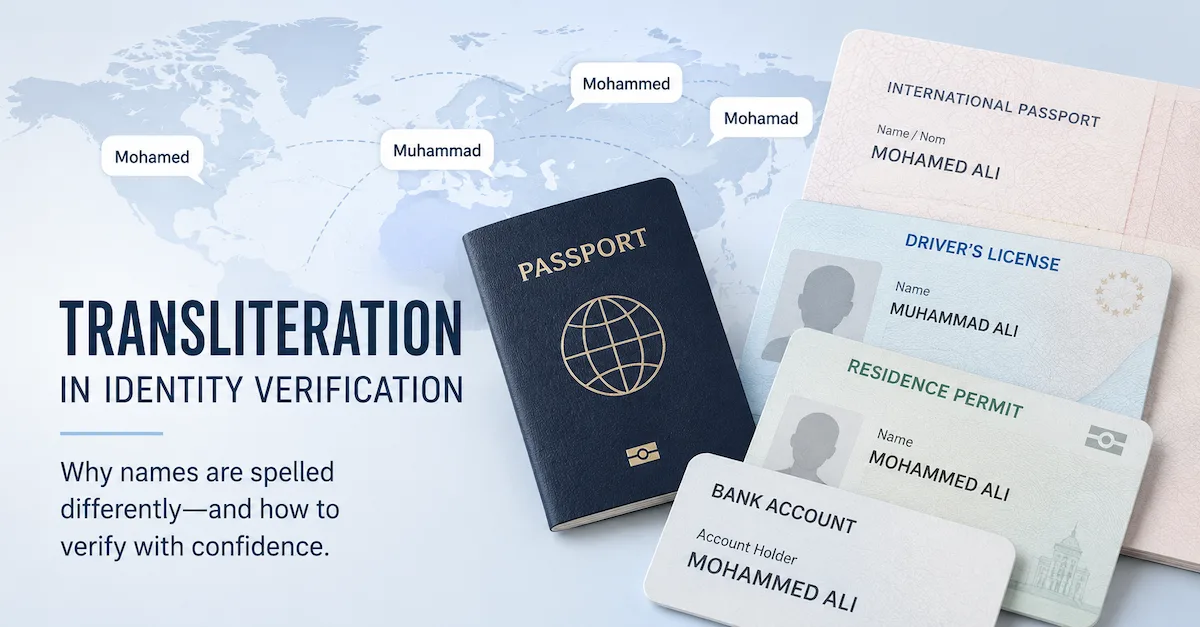

Identity verification has become increasingly global. Financial institutions onboard customers from around the world, hotels welcome international travelers, employers hire foreign nationals, and retailers verify identification from dozens of countries every day. While modern identity verification systems have become highly effective at detecting counterfeit documents and verifying identity information, one challenge continues to generate unnecessary friction: transliteration.
A customer may present a passport that lists their name as Mohamed, a driver’s license that says Muhammad, and a financial record that uses Mohammed. Although all three documents belong to the same individual, an automated system that relies on exact name matching may incorrectly identify the records as belonging to different people.
These situations are far more common than many organizations realize. They are not the result of fraud or clerical mistakes but rather a consequence of how names are converted from one writing system to another. Understanding transliteration is essential for organizations that perform Know Your Customer (KYC) checks, age verification, identity proofing, employee onboarding, or document verification.
What is transliteration?
Transliteration is the process of converting names or words from one writing system into another while preserving their pronunciation as closely as possible.
Unlike translation, which changes the meaning of a word between languages, transliteration changes only the script. A person’s name remains the same name, but it is represented using a different alphabet.
For example, the Arabic name محمد may legitimately appear as Mohamed, Mohammed, Muhammad, Mohamad, or Muhammed. Each spelling represents the same underlying name, yet each follows slightly different transliteration conventions.
| Original Script | Common English Spellings |
| محمد | Mohamed, Mohammed, Muhammad, Mohamad |
| Алексей | Alexey, Aleksei, Aleksey |
| 李 | Li, Lee |
| 張 | Zhang, Chang |
| 김 | Kim, Gim |
None of these spellings are inherently more correct than the others. In many cases, multiple versions are accepted by governments, international organizations, and the individuals themselves.
Why do names appear differently across official documents?
Many people assume governments use one universal spelling for every person’s name. In reality, there is no single global standard for transliterating every language into the Latin alphabet.
Different government agencies often follow different transliteration standards depending on when a document was issued, which department produced it, or which international guidance was in effect at the time. Some countries also allow applicants to choose a preferred Romanized spelling, particularly if that spelling has already been established on previous documents.
As a result, someone may legally possess a passport issued several years ago using one spelling, while a recently issued driver’s license or immigration document uses another. Both documents can be entirely valid despite the differences.
Why transliteration creates identity verification challenges
Most identity verification workflows compare information from multiple sources before confirming an individual’s identity. A passport may be compared with a driver’s license, a customer application, a credit bureau record, or a government watchlist.
When those records contain different transliterations of the same name, systems that depend on exact text matching often generate unnecessary mismatches. These false discrepancies can delay customer onboarding, increase manual review rates, and create frustration for both businesses and legitimate customers.
This challenge becomes even more significant for organizations operating internationally. The more countries, languages, and document types a business accepts, the more frequently transliteration differences appear.
Rather than indicating fraud, these variations often reflect perfectly legitimate differences in how names have been represented over time.
Which languages are most commonly affected?
Transliteration issues can occur in any language that does not use the Latin alphabet, but some writing systems produce more variation than others.
Arabic is one of the most common examples because there is no universally accepted Romanization system. The same name may appear as Mohammed, Mohamed, Muhammad, Mohamad, or Muhammed across different documents.
Chinese names also vary considerably depending on whether they were Romanized using Hanyu Pinyin, Wade-Giles, Cantonese conventions, or personal preference. Familiar examples include Zhang versus Chang and Li versus Lee.
Russian and other languages that use the Cyrillic alphabet often produce multiple accepted spellings as well. Names such as Alexey, Aleksey, and Aleksei may all refer to the same individual.
Korean names frequently differ because Romanization standards have changed over time. While official guidance may recommend one spelling, many families continue using historical spellings that have appeared on passports, educational records, or immigration documents for decades.
Japanese, Greek, Hebrew, Hindi, Thai, Armenian, and numerous other languages present similar challenges, particularly when multiple transliteration systems exist simultaneously.
Transliteration is not the same as a misspelling
One of the biggest misconceptions in identity verification is that every name mismatch represents an error.
A legitimate transliteration is fundamentally different from a typographical mistake.
For example, Mohammed and Muhammad are both accepted transliterations of the same Arabic name. Likewise, Zhang and Chang may both accurately represent the same Chinese surname depending on the Romanization system that was used.
By contrast, a typo introduced during manual data entry, such as “Mohmed” or “Zhnag”, is not a transliteration. These errors occur because information was entered incorrectly rather than intentionally converted from another writing system.
Effective identity verification systems need to distinguish between these two scenarios. Treating every spelling variation as suspicious increases false positives, while treating every mismatch as acceptable increases fraud risk.
Why exact name matching is no longer enough
Historically, many identity verification systems relied on exact text comparisons. If two names matched character for character, the records were considered consistent. If even a single letter differed, the system often generated an exception for manual review.
That approach becomes increasingly ineffective in today’s global environment.
Modern identity verification evaluates multiple pieces of information together rather than relying exclusively on a person’s name. A matching date of birth, document number, issuing authority, machine-readable data, and biometric comparison often provide much stronger evidence that two records belong to the same individual than an exact spelling match alone.
This layered approach reduces unnecessary manual reviews while maintaining strong fraud prevention standards.
OCR, barcodes, MRZs, and RFID all capture names differently
Identity documents store personal information in several different formats, and understanding those formats is important when evaluating transliteration.
Optical Character Recognition (OCR) extracts the name exactly as it appears on the front of the document. If a driver’s license displays “Mohammed,” OCR will capture that precise spelling.
Machine-readable zones (MRZs), commonly found on passports, follow formatting rules established for international travel. Although these standards improve consistency, they cannot eliminate every transliteration difference because they still rely on the spelling chosen when the passport was issued.
Many North American driver’s licenses also contain PDF417 barcodes that encode the cardholder’s information exactly as it exists in the issuing agency’s database. RFID-enabled documents, including electronic passports and some digital identity credentials, likewise store the official name associated with that credential.
Each technology accurately captures the data contained on the document. However, if two different government agencies originally issued credentials using different transliterations, both scans will still be correct even though the spellings differ.
Unicode normalization and transliteration are different problems
Another source of confusion is Unicode normalization.
Unicode normalization addresses situations where identical characters may be encoded differently in digital systems. Transliteration, on the other hand, changes the actual letters used to represent a name.
For example, software may normalize accented characters such as José to ensure consistent digital processing. That is different from converting a Russian, Arabic, or Chinese name into the Latin alphabet.
Organizations performing identity verification should understand both challenges because each can affect automated matching in different ways.
Industries where transliteration matters most
Financial institutions regularly compare customer names across passports, government databases, sanctions lists, and credit records. Minor transliteration differences can trigger unnecessary Know Your Customer (KYC) reviews even when all documents belong to the same individual.
Hotels and hospitality businesses frequently verify passports against reservation systems. When booking information and travel documents use different spellings, front desk staff may need to perform additional verification before completing check-in.
Automotive dealerships compare driver’s licenses against financing applications, insurance records, and identity verification services. Transliteration differences can complicate financing approvals if matching systems rely too heavily on exact spelling.
Healthcare providers also encounter these issues when patients receive treatment across multiple countries or healthcare systems. Matching records accurately is essential for patient safety while avoiding duplicate records.
Government agencies and immigration authorities face these challenges every day because they routinely process documents originating from dozens of countries, each following different transliteration practices.
Best practices for reducing transliteration-related mismatches
Evaluate more than the customer’s name
Names should rarely serve as the sole factor in an identity decision. Verification systems are far more reliable when they consider multiple attributes together, including the date of birth, document number, issuing authority, expiration date, and other identifying information captured directly from the credential.
Reduce manual data entry
Manual typing introduces genuine spelling mistakes that can compound existing transliteration differences. Capturing identity information directly from OCR, PDF417 barcodes, MRZs, RFID chips, or mobile IDs helps ensure names are recorded exactly as they appear on the credential.
Use intelligent matching instead of exact matching
Modern identity verification platforms increasingly use confidence scoring and similarity algorithms rather than simple character-by-character comparisons. These approaches allow organizations to recognize common transliteration patterns while still identifying discrepancies that warrant further investigation.
How AI is improving transliteration matching
Artificial intelligence is making identity verification more resilient to legitimate name variations.
Instead of evaluating only one field, AI-powered verification systems like VeriScan can analyze relationships between multiple identity attributes and recognize common transliteration patterns that traditional rule-based systems often miss. This reduces unnecessary manual reviews while allowing investigators to focus on genuinely suspicious inconsistencies.
AI does not eliminate the need for human oversight or strong fraud prevention controls, but it helps organizations distinguish between expected linguistic variations and anomalies that deserve closer attention.
Transliteration will continue to shape modern identity verification
As businesses increasingly serve international customers, transliteration will become an even more common part of identity verification. Organizations that rely solely on exact name matching are likely to experience higher manual review rates, slower onboarding, and unnecessary customer friction.
The most effective verification strategies recognize that identity cannot be established by a single field alone. Combining accurate ID scanning with intelligent matching across multiple identity attributes allows organizations to reduce false mismatches while maintaining strong protection against fraud.
Understanding transliteration is no longer just a linguistic consideration, it’s an essential component of building identity verification systems that are accurate, scalable, and prepared for an increasingly global world.