Skip to content


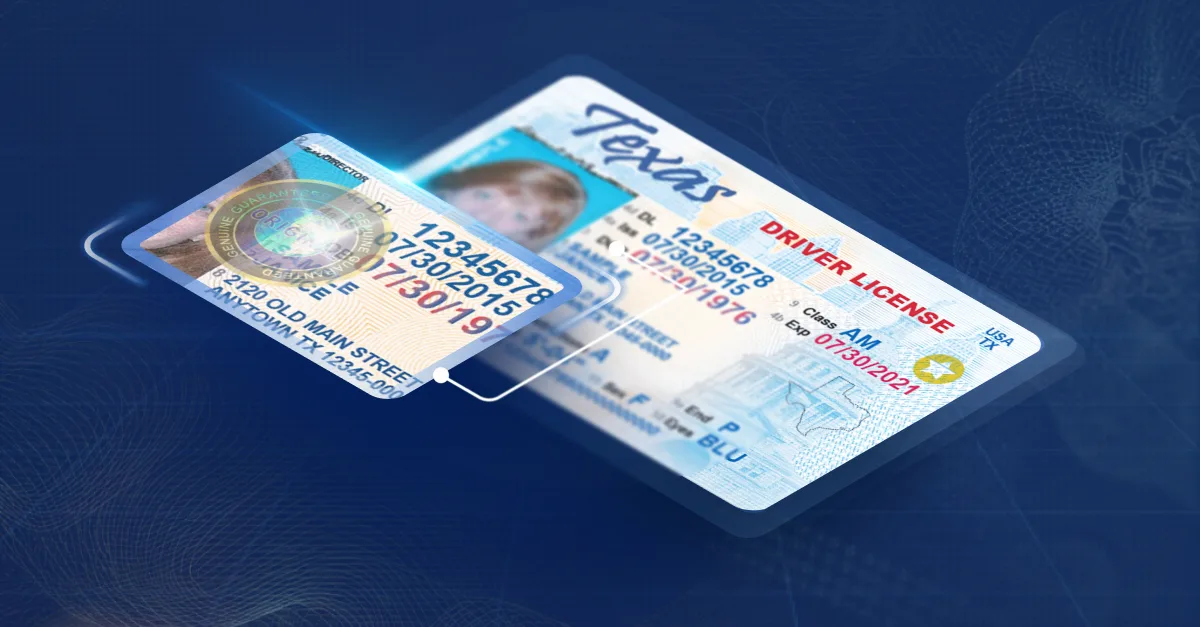

Holograms are one of the most recognizable security features found on U.S. driver’s licenses and identification cards. When an ID is tilted under normal light, holographic images, seals, patterns, or text may appear, disappear, change color, or shift between designs.
These features aren’t just decorative. Holograms and other optically variable devices (OVDs) are designed to make government-issued identity documents more difficult to counterfeit or alter. Because legitimate holographic elements require specialized materials and manufacturing processes, inconsistencies in these features can also help identify potentially fraudulent documents.
Although holograms are common across U.S. IDs, their appearance and implementation vary significantly by state.
What is a hologram on an ID?
A hologram is an optically variable security feature that changes appearance depending on the angle at which it is viewed or illuminated. On an ID, holographic elements are typically incorporated into a transparent laminate, overlay, or another layer of the card.
Depending on the ID design, tilting the card may reveal a state seal, abbreviation, landmark, symbol, portrait, repeating pattern, or other image.
Unlike printed artwork, a genuine holographic feature interacts with light. This makes it more difficult to reproduce using a conventional printer or by simply copying the visible design of an authentic ID.
Holographic features can also overlap with other security technologies. Some modern IDs incorporate optically variable elements alongside ultraviolet imagery, laser engraving, microprint, tactile features, or polycarbonate card construction.
Why are holograms used on driver’s licenses?
Government-issued IDs use multiple layers of security rather than relying on a single feature. These can generally include overt features that can be inspected visually, covert features that require specialized lighting or equipment, and forensic features designed for examination by trained professionals.
Holograms are particularly useful because many are overt security features. A bartender, bank employee, security professional, retailer, or other person inspecting an ID may be able to tilt the document and confirm that an expected holographic effect is present.
However, simply seeing something reflective on an ID does not prove that the document is authentic. Sophisticated counterfeit IDs can include simulated holograms and reflective overlays. ID verification becomes stronger when the hologram is evaluated alongside other document features.
What should a hologram on a legitimate ID look like?
There is no universal hologram used across U.S. driver’s licenses. Every issuing jurisdiction controls its own card design, and those designs change periodically.
A legitimate hologram should generally behave consistently with the security feature specified for that particular document format. Depending on the ID, this could mean that an image appears only at a specific angle, an element switches between light and dark, a pattern moves as the card is rotated, or a state-specific image becomes visible.
This is why ID inspection requires more than simply asking whether a card “has a hologram.” The holographic feature needs to match what is expected for that exact state and ID format.
Examples of holograms on U.S. IDs
Holographic security features are used across numerous U.S. identification documents. However, states do not always publicly disclose every element incorporated into their cards. The following are several examples where issuing authorities or other official documentation have publicly described holographic or optically variable features.
Arizona ID holograms
Arizona introduced a redesigned polycarbonate credential with multiple advanced security elements. The design incorporates angle-dependent visual features as well as imagery visible under ultraviolet illumination.
The ID includes Arizona-specific imagery such as a howling coyote and desert-themed elements. These state-specific designs help make the credential visually distinctive while adding additional barriers against counterfeiting.
California ID holograms
California began issuing a redesigned driver’s license and ID card in 2025 featuring updated technology and advanced security measures.
Not every security feature incorporated into a driver’s license is publicly disclosed, which is intentional. Limiting publicly available information about certain document security features makes them more difficult for counterfeiters to reproduce.
Businesses should therefore evaluate California credentials according to the specific ID format and issuance period rather than relying on a single visual feature.
Illinois ID holograms
Illinois driver’s licenses and identification cards use several layers of anti-counterfeiting technology. Public documentation has identified holographic or overlay elements alongside ultraviolet imagery, microprint, laser perforation, and other tamper-resistant features.
This illustrates an important characteristic of modern ID design: holograms rarely operate alone. They are one component of a broader system intended to make the entire credential more difficult to reproduce.
New York ID holograms
New York IDs incorporate multiple visible and covert security elements, including UV-reactive imagery and repeating patterns.
Reflective and optically variable elements add another layer to the inspection process. Because New York has issued several document formats over time, businesses should ensure that the security features they expect correspond with the particular credential being presented.
Oregon ID holograms
Oregon’s driver’s license documentation has specifically identified a tamper-resistant laminate that displays holographic imagery under certain viewing angles and lighting conditions.
State-specific imagery incorporated into these effects can include recognizable Oregon landmarks and symbols. The feature provides both an overt inspection tool and another obstacle for counterfeit document manufacturers.
Pennsylvania ID holograms
Pennsylvania provides one of the more distinctive examples of an optically variable ID security feature.
PennDOT has documented a black-and-white switching holographic overlay incorporating the Pennsylvania keystone. As the viewing angle changes, the feature reverses between black and white.
Instead of merely confirming that a reflective image exists, an inspector can therefore look for a specific optical behavior associated with the legitimate Pennsylvania credential.
Can fake IDs have holograms?
Yes. The presence of a hologram does not automatically mean an ID is legitimate.
Modern counterfeiters can add reflective films, metallic overlays, simulated holograms, and other elements designed to resemble authentic ID security features. Some may look convincing during a quick visual inspection.
The more useful question is whether the hologram behaves and appears exactly as expected for the document being presented.
A fake ID may contain a hologram that is positioned incorrectly, displays the wrong imagery, has an inaccurate optical effect, lacks sufficient detail, or does not correspond with the legitimate document format.
This is one reason visual inspection alone is increasingly difficult when businesses encounter sophisticated fake IDs.
Holograms vs. UV security features
Holograms and UV imagery are sometimes confused, but they are not the same security technology.
Most holographic or optically variable features interact with normal visible light and change as the credential is tilted. UV features are designed to become visible or behave differently when exposed to ultraviolet light.
Some credentials incorporate both technologies, and certain advanced security elements may combine optical effects with UV-responsive materials.
For businesses, this distinction matters because UV inspection requires an ultraviolet light source, while many overt holographic elements can be inspected under ordinary lighting.
How ID authentication checks holograms
Manual hologram inspection can be useful, but it depends on the person checking the ID knowing exactly what should appear on that specific credential.
ID authentication provides a more systematic approach.
Authentication-capable ID scanners can capture high-resolution images of an identity document and analyze security features against known templates for the expected document format. Depending on the hardware and software being used, ID authentication can incorporate white-light imaging, ultraviolet and infrared analysis, barcode security checks, OCR-based front-and-back comparisons, and hologram or watermark checks.
Instead of relying on one visible feature, ID authentication evaluates multiple characteristics of the credential simultaneously.
Why hologram verification matters for businesses
Businesses in age-restricted retail, nightlife, financial services, automotive, transportation, hospitality, gaming, and other industries routinely depend on government-issued IDs to make important decisions.
A visual hologram check can provide a useful first layer of inspection, but increasingly sophisticated fake IDs make it risky to rely on a single feature.
For example, an ID may have a convincing holographic overlay while containing incorrect barcode data or missing expected UV imagery. Alternatively, the physical document may be genuine but have been altered or presented by someone other than the legitimate cardholder.
The strongest ID verification workflows therefore evaluate the document as a whole.
How IDScan.net helps detect fake IDs
IDScan.net’s ID authentication technology evaluates IDs using hundreds of algorithmic checks designed to identify fake and suspicious documents.
When paired with authentication-capable hardware, VeriScan Identity Platform can evaluate features that extend well beyond the information stored in the 2D barcode. Depending on the document and hardware configuration, checks can include high-resolution document imagery, ultraviolet and infrared features, front-to-back data matching, barcode security, holograms, watermarks, microprint, and other state-specific security elements.
This allows businesses to evaluate whether the physical document matches the expected template for the ID being presented rather than relying solely on whether an ID looks legitimate.
The future of holograms on U.S. IDs
U.S. driver’s licenses continue to become more sophisticated as states introduce new card formats and transition toward technologies such as polycarbonate construction and laser engraving.
Holographic security is evolving alongside these changes. Traditional reflective overlays are increasingly being supplemented by more sophisticated optically variable elements, transparent features, laser-generated effects, and other technologies that are substantially more difficult to reproduce.
Although the appearance of these security features will continue to change, their purpose remains the same: make authentic ID credentials easier to verify and fraudulent ID credentials harder to manufacture.
For businesses checking IDs, understanding holograms is useful, but combining that knowledge with comprehensive ID authentication provides a much stronger defense against modern ID fraud. Implementing ID scanning into workflows can ensure compliance while reducing fraud.