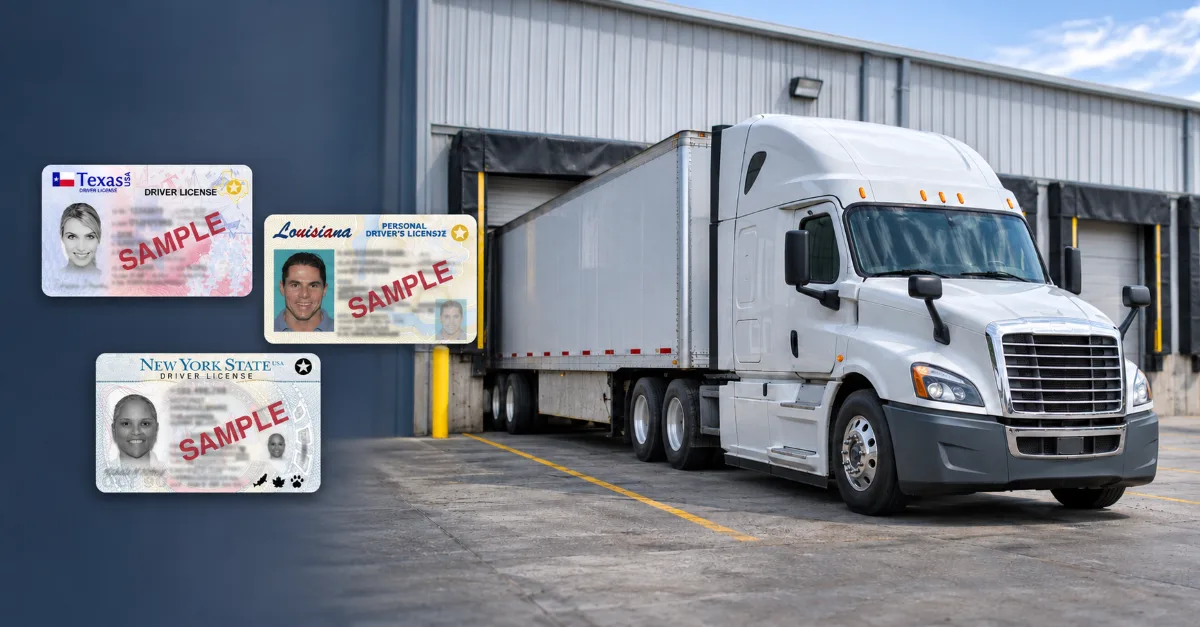

A driver arrives at a distribution center with a commercial driver’s license (CDL), a pickup number, and a bill of lading. The guard needs to know whether the person standing at the gate is authorized to leave with the load. Asking the driver to show a license, reading the barcode, and saving a copy in the transportation management system are three separate actions. State law can allow one and restrict another.
Texas expressly permits electronic license-data use for security at qualifying maritime facilities and ports when the facility’s executive or administrative head authorizes it. California permits scanning California DMV credentials for specified purposes, including document authentication and required fraud-prevention use. Florida provides an informed-consent route for capturing and storing physical-license data. New Hampshire provides a narrow authorization for a scan configured around name and license number. A standard warehouse workflow needs its own analysis in each of those states. Oregon’s enumerated exceptions, for example, provide no clear authorization for routine warehouses.
What counts as ID scanning at a freight site?
This guide covers a private warehouse, distribution center, cross-dock, freight yard or terminal inspecting a CDL or driver’s license voluntarily presented by a commercial driver. The primary question is whether the facility can electronically read the credential and keep the resulting personal information. State rows call out additional rules for images, mobile IDs, and biometrics where the distinction changes the answer. A regulated port, driver hiring, a motor vehicle record pull, and delivery of age-restricted goods can each trigger separate rules.
A barcode read decodes information printed in machine-readable form. Document authentication checks whether the credential appears genuine. Identity verification ties the credential to its presenter. Pickup authorization ties that individual and carrier to a particular load. A genuine CDL can pass ID authentication while the presenter fails the pickup authorization check.
Where federal rules fit
FMCSA registration and driver qualification
FMCSA launched Motus on May 19, 2026. Its first-login instructions call for an identity check using images of the user’s face and government-issued ID, with in-person verification available. This check serves the federal registration system. At a warehouse, the operator still needs a state-law basis for collecting or retaining a visiting driver’s license data. Separately, 49 CFR §§ 391.23 and 391.51 govern motor carriers’ driver investigations and qualification files where applicable. A motor carrier’s duty to keep a driving record or a license copy accepted in place of a road test certificate establishes a specific recordkeeping purpose.
TWIC and maritime facility access
Under 33 CFR § 105.255, facilities covered by the maritime security regulations implement access controls and applicable Transportation Worker Identification Credential (TWIC) inspections. The inspection requirements depend on the facility and access involved. The Texas maritime exception is a distinct state-law provision for electronically readable driver’s license information. Florida also authorizes specified seaports to adopt supplemental security measures and requires port-specific security plans. A terminal using both credentials should document the authority and purpose for each check.
REAL ID, DMV records and background screening
REAL ID’s machine-readable technology standard specifies information a compliant ID must encode. The availability of the barcode does not grant a private business permission to collect its contents. The Driver’s Privacy Protection Act (DPPA) governs personal information obtained from state motor vehicle records, including permissible use and redisclosure. Reading an ID presented at a gate and obtaining information from a DMV or a vendor using DMV records are distinct workflows. If a screening provider supplies a consumer report for employment, the Fair Credit Reporting Act can trigger disclosure, authorization, and adverse-action requirements.
Driver ID scanning laws in all 50 states
| State | What the law means at a freight gate | Legal text and status |
| Alabama | No gate-specific rule identified. The 2026 consumer privacy legislation creates separate duties for covered processing. | Ala. Code §§ 8-38-1 et seq. (breach). HB 351, enrolled text, effective May 1, 2027. |
| Alaska | No gate-specific rule identified. Review breach duties if you keep identifiable license details in gate records. | Alaska Stat. §§ 45.48.010–.095 (breach). |
| Arizona | No gate-specific permission identified. Review rules on retaining or transmitting customer information where the gate also serves customers. A commercial pickup should be assessed on its own facts. | A.R.S. § 44-7701. A.R.S. §§ 18-551–552 (breach). |
| Arkansas | No gate-specific rule identified. Stored driver information can trigger safeguarding and breach duties. | Ark. Code §§ 4-110-101 et seq. |
| California | Purpose-limited. A business may scan a California DMV credential for specified purposes, including document authentication and processing information required to prevent fraud. Keep and use scan data only for an authorized purpose. | Cal. Civ. Code § 1798.90.1. CCPA, Cal. Civ. Code §§ 1798.100 et seq., is a separate inquiry. |
| Colorado | No gate-specific barcode rule identified. If the gate uses a face template, review Colorado’s biometric provisions, including its treatment of employees and prospective employees. | Colo. Rev. Stat. §§ 6-1-1303–1304 (privacy scope), § 6-1-1314 (biometrics), § 6-1-716 (breach). |
| Connecticut | No gate-specific permission identified. The tobacco and vapor transaction-scan rules apply to the covered sales. Analyze gate records separately under applicable privacy and breach law. | Conn. Gen. Stat. §§ 53-344 and 53-344b. §§ 42-515 et seq. (privacy), § 36a-701b (breach). |
| Delaware | No gate-specific rule identified. A proposal to regulate merchant reads of machine-readable ID data stopped short of enactment. The state privacy law presents a separate coverage question. | 6 Del. C. chs. 12B (breach) and 12D (privacy). Official disposition of SS 1 for SB 255. |
| Florida | Informed-consent route. A driver can consent to a physical-ID swipe for collection and storage after being told which information is collected and why. The statute provides for manual collection when the person declines the swipe and bars withholding goods or services solely because manual collection is requested. | Fla. Stat. § 322.143(6)–(8). § 322.032 separately addresses digital credentials. |
| Georgia | Prior knowledge and consent required. Georgia prohibits scanning a person’s driver’s license, permit or identification card without the person’s prior knowledge and consent. Apply that requirement before scanning at a freight gate and evaluate retention separately. | O.C.G.A. § 40-5-120(5). Georgia DDS statutory reference · 2025 Georgia Attorney General guidance. O.C.G.A. §§ 10-1-910–912 (breach, with scope limits). |
| Hawaii | Purpose-limited. One exception allows a business to scan to establish or maintain a contractual relationship and collect only four named fields. A shipper’s contract with a carrier should be examined before relying on that exception for the individual at the gate. | Haw. Rev. Stat. § 487J-6(a)(4), (b)–(e). |
| Idaho | No gate-specific rule identified. Gate databases that contain covered personal information may trigger breach obligations. | Idaho Code §§ 28-51-104–107. |
| Illinois | Purpose and disclosure restrictions. The driver’s-license statute limits use unrelated to the transaction in which the data was obtained and also regulates disclosure, with statutory exceptions including express permission. Face geometry can separately trigger BIPA. | 625 ILCS 5/6-117.1. 740 ILCS 14/15. |
| Indiana | No gate-specific rule identified. Evaluate whether the individual qualifies as a consumer before applying Indiana’s consumer privacy law to commercial driver records. | Ind. Code art. 24-15 (privacy, effective 2026) and art. 24-4.9 (breach). |
| Iowa | No gate-specific rule identified. The consumer privacy law applies only when its definitions and coverage tests are met. | Iowa Code ch. 715D (privacy), ch. 715C (breach). |
| Kansas | No gate-specific rule identified. Review Kansas breach duties for stored license information. | Kan. Stat. §§ 50-7a01–04. |
| Kentucky | No gate-specific physical-card rule identified. Kentucky provides separate business guidance for verifying a mobile credential. | KRS ch. 367, including § 367.170 and §§ 367.3611–367.3629 (privacy). Kentucky Transportation Cabinet mobile ID guidance. |
| Louisiana | No gate-specific physical-card rule identified. Louisiana separately addresses acceptance of digitized ID. Its 2026 privacy act takes effect January 1, 2027. | La. R.S. 51:3212. 2026 legislative digest, La. R.S. 51:1780.1–.5. |
| Maine | No gate-specific rule identified. The license-content statute addresses issuance and treatment of images held by the issuing authority. Private gate records require a separate data-handling analysis. | 29-A M.R.S. § 1401. 10 M.R.S. §§ 1346–1350-B (breach). |
| Maryland | No gate-specific rule identified. The 2026 swiping bill remained at the hearing stage. The Maryland Online Data Privacy Act imposes separate duties for covered processing. | SB 695 official status. Md. Code, Com. Law §§ 14-4601 et seq. (privacy), §§ 14-3501 et seq. (information protection). |
| Massachusetts | No gate-specific rule identified. The state’s information security rules warrant particular attention where gate logs contain a Massachusetts resident’s name plus driver’s license or state ID number. | Mass. Gen. Laws ch. 93H. 201 CMR 17.00. |
| Michigan | No gate-specific barcode rule identified. License issuance and the Secretary of State’s use of images are separate from private physical-card check-in. | MCL § 257.310. MCL §§ 445.63, 445.72 (breach). |
| Minnesota | No gate-specific rule identified. Assess privacy coverage and security separately if the facility retains scan-derived personal data. | Minn. Stat. §§ 325M.10 et seq. (privacy), § 325E.61 (breach). |
| Mississippi | No gate-specific physical-card rule identified. Staff should treat credential issuance provisions separately from their own capture and retention policy. | Miss. Code § 63-1-35 (license format), § 75-24-29 (breach). |
| Missouri | No gate-specific rule identified. Evaluate the site’s gate records under the breach statute and distinguish state licensing-agency practices from private scanning. | Mo. Rev. Stat. § 407.1500 (breach). |
| Montana | No gate-specific rule identified. Assess coverage under the Montana Consumer Data Privacy Act as amended, including the commercial and employment context. | Mont. Code Ann. §§ 30-14-2801 et seq. (privacy), § 30-14-1704 (breach). |
| Nebraska | No gate-specific rule identified. Nebraska’s data-security statute imposes safeguards on covered personal information. The scanning-device offense in § 28-634 concerns payment cards. | Neb. Rev. Stat. § 87-808 · § 28-634. §§ 87-1101 et seq. (privacy). |
| Nevada | No gate-specific rule identified. Determine whether Nevada’s security, encryption, and breach requirements apply before storing or transferring a driver’s details. | NRS ch. 603A, especially §§ 603A.210–.220. |
| New Hampshire | Limited scan authorization. The Department of Safety authorizes a narrow scanning configuration around name and license number. Broader collection, display, storage or transfer requires separate analysis under the Department’s authorizations. | RSA 263:12, X · Saf-C 5606.02 and .04–.08. |
| New Jersey | Retail scope for physical cards. The physical-card statute regulates retail establishments. A standalone, non-retail warehouse typically presents a different fact pattern. The 2025 digital-ID act extends the scanning provision to digital verifiers when the act takes effect. | N.J.S.A. 56:11-53–55 · P.L. 2025, c.115, §§ 4–6 and 12, effective 44 months after July 23, 2025. |
| New Mexico | No gate-specific physical-card rule identified. The state’s mobile-ID verifier guidance applies to its mobile credential. Retained gate data can trigger separate security obligations. | N.M. Stat. §§ 57-12C-1 et seq. New Mexico MVD mobile-ID business guidance. |
| New York | No gate-specific rule identified. Senate bills S7426 and S10418 propose machine-readable scanning restrictions under § 399-ss. The liquor transaction-scan statute applies to its own context. | S7426 · S10418 · ABC Law § 65-b · GBL § 899-bb. |
| North Carolina | Color-copy restriction. Section 20-30(6) expressly permits black-and-white reproduction and contains specific exceptions for color images. Review any kiosk that captures a color image of the license separately from a barcode-only setup. | N.C. Gen. Stat. § 20-30(6). |
| North Dakota | No gate-specific physical-card rule identified. The state’s mobile-ID guidance describes a separate method of credential verification. | N.D.C.C. ch. 51-30 (breach). NDDOT Mobile ID for Business. |
| Ohio | No gate-specific rule identified. Ohio’s transaction-scan provision pertains to the statutory alcohol transaction and does not establish a freight-gate process. | Ohio Rev. Code § 4301.61. § 1349.19 (breach). |
| Oklahoma | No gate-specific rule identified. The 2026 consumer privacy measure creates a separate future compliance question. | SB 546 official history and enrolled text. 24 O.S. §§ 161–166 (breach). |
| Oregon | Purpose-limited. The law applies to private entities and reaches licenses issued by other jurisdictions. Routine freight check-in has no clear standalone exception. Storage, sale and sharing of personal information are prohibited for scans under the statute’s authenticity or qualifying identity provision and its age provision. | ORS 807.750(1)–(6), (8). |
| Pennsylvania | No gate-specific rule identified. Retained details should be reviewed under the Breach of Personal Information Notification Act. | 73 P.S. §§ 2301 et seq. |
| Rhode Island | No gate-specific rule identified. The Rhode Island Data Transparency and Privacy Protection Act has been effective since January 1, 2026. Review its applicability and the separate identity-theft protection statute. | R.I. Gen. Laws chs. 6-48.1 (privacy) and 11-49.3 (identity theft protection). |
| South Carolina | No gate-specific rule identified. Review the state’s breach definition and identity-theft provisions for retained driver records. | S.C. Code § 39-1-90. |
| South Dakota | No gate-specific rule identified. The state’s barcode provisions deal with credential contents. Separate breach rules can apply to retained gate data. | SDCL §§ 32-12-17.9–.10. SDCL ch. 22-40 (breach). |
| Tennessee | No gate-specific rule identified. Evaluate the Tennessee Information Protection Act using its actual applicability test and the context of the gate visit. | Tenn. Code §§ 47-18-3301 et seq. (privacy), § 47-18-2107 (breach). |
| Texas | Express port and maritime security exception. Qualifying facilities can use electronically readable license data for security, with authorization from the executive or administrative head. Routine private warehouse barcode reading has no clear general exception. | Tex. Transp. Code § 521.126(b)–(h). Tex. Bus. & Com. Code § 503.001 separately addresses commercial biometric capture. |
| Utah | No gate-specific physical-card rule identified. The Utah Consumer Privacy Act is a separate coverage analysis. | Utah Code §§ 13-61-101 et seq. (privacy), §§ 13-44-101 et seq. (information protection). |
| Vermont | Database restriction with fraud and security relevance. A statute limits databases of electronically readable information from listed licenses and ID cards and exempts qualifying prevention of fraud, abuse or other criminal conduct. | 23 V.S.A. § 7(c). 2026 Act 138 addresses data brokers and personal information separately. |
| Virginia | Fixed-retail scope. The barcode law applies to merchants selling goods from a fixed retail location in Virginia. Examine that definition if the gate also serves a retail operation. Out-of-state credentials are expressly addressed by the scan provision. | Va. Code § 59.1-442 · § 59.1-443.3. |
| Washington | Technology-specific rules. Review the radio-frequency provisions for RFID and the relevant biometric chapter for facial templates. A conventional optical gate scan is a different technology. | RCW 19.300.030 · RCW 9A.58.020 · RCW ch. 19.375. |
| West Virginia | No gate-specific rule identified. The alcohol-related verification provisions address covered licensees and sales. The breach statute is relevant if the gate retains covered personal information. | W. Va. Code ch. 11, art. 16. W. Va. Code §§ 46A-2A-101 et seq. (breach). |
| Wisconsin | Conditional copying permission. A license copy may be made to identify the license holder, subject to limits on sale, transfer, and keeping the photo in an image library. Barcode-only extraction raises a separate question under the rule’s wording. | Wis. Admin. Code Trans § 102.205. Wis. Stat. § 134.98 (breach). |
| Wyoming | No gate-specific rule identified. The license-content rules and data breach rules serve different purposes. | Wyo. Stat. tit. 31. Wyo. Stat. §§ 40-12-501–502 (breach). |
The state laws that change how a gate can operate
Texas explicitly addresses port and maritime security
Texas Transportation Code § 521.126(b) generally prohibits accessing or using electronically readable information from a driver’s license, CDL, or personal identification certificate, or compiling or maintaining a database of that information, unless an exception applies. A violation is a Class A misdemeanor. The distinction matters at an inland distribution center because the prohibition reaches access and use, even if the ID scanner deletes the data afterward. The check-transaction, government, health-care, and other specific exceptions have their own terms. The statute supplies no blanket exception based on a visiting driver’s consent.
Subsection (g) directly addresses a logistics environment. If the executive or administrative head authorizes it, a qualifying maritime facility, port, port authority or navigation district may access, use, compile or maintain that information to secure the site. Enumerated uses include identifying individuals, issuing official credentials, tracking or restricting movement on facility property, maintaining a secure visitor database and using the information at terminals and gates. Subsection (h) provides confidentiality protection against public disclosure, subject to the cited exception. The statute ties this authority to the qualifying site and its security operations. An off-site warehouse in the same freight network should establish its own basis before using the same scanner settings.
California and Vermont provide different fraud-prevention pathways
California Civil Code § 1798.90.1(a)(1)(A) permits a business to scan or swipe a California DMV-issued credential to verify its authenticity. Subparagraph (D) separately allows collection or disclosure of personal information required for reporting, investigating or preventing fraud, abuse, or material misrepresentation. That can matter where a facility is investigating a fictitious pickup or identifying what information is needed to prevent one. Subdivision (a)(3) limits retention and use to statutory purposes. A violation is a misdemeanor punishable by up to one year in county jail, a fine of up to $10,000, or both. The statutory text ties the permission to DMV-issued cards, so an interstate operator should account for the issuer as well as the site location.
Vermont’s 23 V.S.A. § 7(c) focuses on compiling or maintaining a database of electronically readable information from the listed credentials. It contains an exception for prevention of fraud, abuse, or other criminal conduct, among other specified purposes. A facility relying on that exception should tie the database’s fields and uses to the fraud or theft risk it is addressing. Routine attendance analytics and maintaining a record for investigating suspicious pickups serve different purposes.
Georgia, Florida, Oregon and Hawaii differ on consent and transaction purpose
Georgia’s O.C.G.A. § 40-5-120(5) directly addresses the act of scanning the credential. The cardholder’s prior knowledge and consent matter even if the site intends to discard the scan result. The Attorney General’s 2025 retail guidance reinforces that consent comes before an ID scan can take place.
Florida’s statute gives private entities an informed-consent route to swipe a physical ID and collect and store personal information. The driver must be told what the facility collects and why it uses the information. The manual alternative is part of the statutory design. If the facility instead swipes under the authenticity or qualifying identity provision, or the age provision, subsection (3) bars storage, sale, and sharing of the resulting personal information. The civil penalty can reach $5,000 per occurrence.
Oregon’s rule covers private entities broadly and defines driver licenses to include credentials from other jurisdictions. Its authenticity or identity provision appears alongside conditions involving noncash payment, a return or a refund. The fraud provision concerns returns or refunds involving a fraud prevention company or system. Those clauses offer no clear basis for treating an ordinary pickup appointment as a covered transaction. Oregon also limits when information may be stored or shared and awards a successful private claimant the greater of actual damages or $5,000, plus reasonable costs and attorney fees. Ordinary warehouses should evaluate a visual check with independent load authorization when their facts fall outside the listed purposes.
Hawaii lists establishing or maintaining a contractual relationship as a permitted purpose. It limits collection under that provision to the individual’s name, address, date of birth and license or ID number. Before relying on it, determine which parties have the relationship and how the individual’s identity check serves it. Hawaii allows retention and third-party dissemination only within the listed exceptions and expressly voids waivers of the statute.
New Hampshire distinguishes electronic scanning from electronic recordkeeping
RSA 263:12, X makes Department of Safety authorization central to knowingly scanning, recording, retaining or storing personal information electronically from a driver’s license. Saf-C 5606.05 authorizes a scan if the equipment limits visible personal information, retention, transfer, and repository storage as specified, with only name and license number excepted from those equipment restrictions. Saf-C 5606.06 addresses retention and transmission separately and includes additional conditions for covered businesses. Saf-C 5606.08 provides a written approval process for workflows outside existing authorizations. A visual check may corroborate information obtained directly from the individual under Saf-C 5606.02(b). That distinction matters when designing a manual fallback.
New Jersey and Virginia hinge on the type of establishment
New Jersey addresses physical machine-readable scans by retail establishments. For scans performed under its authenticity or qualifying identity provision and under its age provision, a covered retailer may not retain the information. The statute sets penalties of $2,500 for a first violation and $5,000 for subsequent violations. An aggrieved person can bring a damages action. New Jersey’s 2025 digital-ID act separately applies the scanning section to digital verifiers, regardless of the technical means of reading, once the act takes effect. For a physical card at a warehouse, start with whether the operation is a retail establishment. For a mobile ID, check the verifier rules and effective date separately.
Virginia defines merchant for its scanning law as a person or entity selling goods from a fixed retail location in Virginia. A dedicated business-to-business freight yard differs from a location that combines retail sales, returns, and freight operations. Where the law applies, check the specific permitted purpose and destroy retained data once that purpose is satisfied.
When a face match changes the legal analysis
A guard visually comparing a driver with a printed photo differs from software measuring facial geometry. Illinois BIPA requires covered private entities to give written notice of the collection, purpose and term and obtain a written release before covered collection. It also requires a public retention and destruction policy for entities in possession of covered data. The law provides a private right of action. Its 2024 amendment limits recovery for repeated collection of the same person’s data using the same method and separately addresses repeat disclosures to the same recipient using the same method. Texas separately regulates capture of biometric identifiers for a commercial purpose under Business & Commerce Code § 503.001. Washington’s law includes a narrow definition of commercial purpose and a security-purpose provision. Colorado has biometric-specific rules that warrant review even for workforce use. Determine whether a kiosk or provider generates or retains a covered template, what happens during liveness detection, and whether an image or template is sent to another party.
How to design a freight gate check around the law
Start with the pickup record
Use the scheduled carrier, load number, appointment time, and independently confirmed pickup instructions to establish who should be there. Ask the driver for the information needed to reconcile that record. Where the logistics facility can complete its process with a visual inspection, record the operational result and the shipment reference as applicable. If the site needs an electronic ID scan, document the legal basis for capture and check what data the ID scanning software sends to the screen, visit history, exports, integrations, and backups.
Decide what belongs in the permanent record
A site may need evidence that a guard checked a driver’s identity before releasing a shipment. A full barcode payload, a color image of the credential, and a biometric template each create a different data record. Where data retention is permitted, choose the fields that serve the stated purpose, limit access, and set a deletion schedule. Where data retention is restricted, check every destination that might receive the data, including device storage, screenshots, audit logs, and webhooks. Follow the applicable privacy laws when a driver declines an electronic ID scan, and train guards to escalate discrepancies before releasing cargo.
How IDScan.net can help
VeriScan Identity Platform gives facility operators configurable options for visitor data collection and retention. An operator can align those settings with the fields and retention period approved for a site, then test what reaches the gate log and connected systems. A multi-state team can use separate workflows for visual-only sites, permitted electronic verification, and authorized port operations.
This article provides general information. Applicability depends on the site, the credential, the purpose, and what the system does with the data.