
The most effective cargo thieves don’t break into trailers. They show up at the dock with paperwork, a truck, and a driver’s license that says they’re supposed to be there.
In 2026, strategic cargo theft kept shifting away from smash-and-grab burglary and toward deception: fake carriers, hijacked motor carrier identities, impersonated drivers, and counterfeit IDs presented at the shipping window. The load leaves the facility willingly, and by the time anyone realizes the driver wasn’t who they claimed to be, the freight is gone.
We’ve rounded up notable 2026 cases where fake IDs or stolen identities played a role, what they reveal about how these schemes work, and how shippers, warehouses, and brokers can stop them.
2026 cargo theft cases built on fake IDs and false identities
One driver, six licenses, 24 stolen loads worth $12 million
Federal agents arrested Nursulton Khaydarov in Ontario, California, on June 1. He was later indicted in Connecticut and pleaded not guilty in October. Prosecutors say Khaydarov and his partners bought or took over established trucking companies, assumed their DOT and MC numbers, business email accounts, and even the previous owners’ identities, then booked loads from brokers under names shippers already trusted.
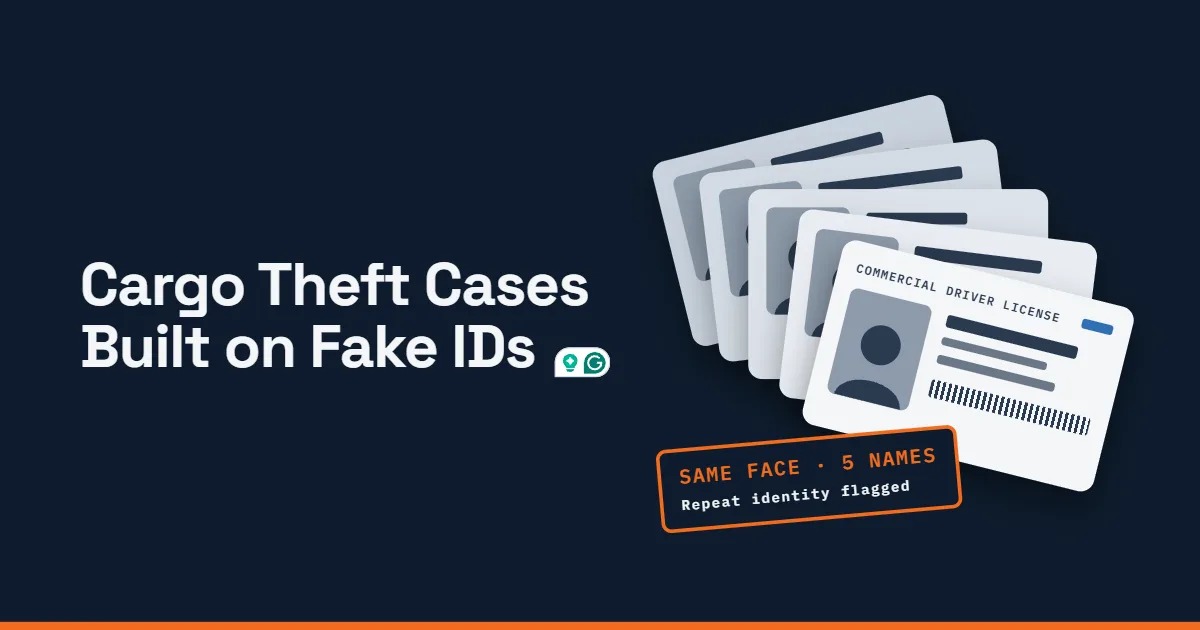
The driver identities were fake too. Court documents describe five fraudulent driver’s licenses in different names, each showing Khaydarov’s photo with altered facial features, alongside his real New Jersey CDL. Prosecutors tie him to at least 24 loads worth more than $12 million, including hard drives, electronics, clothing, and nicotine products.
Eight indicted for impersonating carriers across the Northeast
The Manhattan District Attorney’s Office indicted eight men accused of impersonating legitimate shipping carriers to steal nearly $5 million in goods from logistics sites in Pennsylvania, Virginia, and New Jersey between October 2025 and April 2026. Prosecutors say hackers stole real shipment details from carriers and brokers, and the defendants used that information to show up at warehouses as the assigned carrier. Stolen loads included beef, lamb, cheese, copper, and cigarettes.
One pickup from the case shows how routine the theft looked. According to prosecutors, a driver collected $432,000 worth of specialty cheese from a warehouse in Elizabeth, New Jersey, presenting a license along with the correct pickup number and address. The same truck was stopped six days later only because workers at a Vineland facility noticed its carrier placard was improperly attached.
$2.86 million in tungsten oxide picked up with fraudulent documents
A California driver allegedly used fraudulent documents to pick up nearly 40,000 pounds of tungsten oxide powder in Pennsylvania. The shipment, valued at $2,857,500, was bound for a customer in Japan. Greenfield, Indiana police stopped the truck on I-70 two days later, arrested the driver on a Pennsylvania warrant, and recovered the cargo.
Fake FedEx drivers with counterfeit CDLs take $680,000 in electronics
Two men arrived at a consumer electronics warehouse in New Castle, Delaware, said they were FedEx drivers, and presented commercial driver’s licenses and shipping documents. Warehouse staff released a loaded trailer. The shipper later realized the paperwork was fraudulent and found the trailer at a shopping center in Newark, Delaware. State Police determined that the CDL and the truck’s license plate were both fake. One man was arrested, the cargo was recovered intact, and the second man remains unidentified.
What these cases have in common
The pickup looks legitimate on paper. In every case, the driver arrived with what the warehouse expected to see: a carrier name, a pickup number, shipping documents, and a license. The FBI warned about exactly this pattern in an April 2026 alert covering hijacked email accounts, doctored paperwork, and tampered contact records.
The driver’s license is the weakest link. Counterfeit CDLs got two men a $680,000 trailer in Delaware. One driver allegedly carried five fake licenses with his own photo under different names. Shipping documents and carrier credentials can be checked against the broker, but the license is usually the only thing tying the person at the window to the load, and most facilities check it by eye.
Identity theft happens at the company level too. The $12 million scheme didn’t just fake drivers. It took over real carriers’ DOT and MC numbers, email accounts, and owner identities. The Manhattan ring used hacked shipment details to pose as the assigned carrier. When the carrier looks trustworthy, the driver becomes the last point where something can still be verified.
Fictitious pickups are holding steady. CargoNet reported cargo theft losses reached $718.9 million through September 2026, with fictitious pickups accounting for 25% of Q3 incidents, up from 18% a year earlier.
A copy of a fake license is a dead end. When a load disappears, investigators often find the only record of the driver is a photocopy of a license that turns out to be fraudulent. A verified scan and photo taken at the dock gives law enforcement something to work with.
How to verify the driver, not just the paperwork
Shippers, warehouses, and distribution centers can’t control whether a broker’s inbox gets hacked. They can control what happens at the gate and the shipping window. IDScan.net’s VeriScan turns a glance at a license into a consistent, recorded check:
- Document authentication: VeriScan checks driver’s licenses and CDLs against security features like the 2D barcode and UV/IR markers, so counterfeits like the ones presented in Delaware are flagged instead of waved through.
- Front/back crossmatching: Data printed on the front of the card is compared with the encoded barcode on the back. A license made by altering a real card’s printed details shows a mismatch.
- Face matching: Comparing the driver at the window to the photo on the ID catches someone presenting another person’s license.
- Repeat offender detection: With VeriScan, facilities can flag the same face appearing under different names. That’s the pattern in the $12 million case, where one driver allegedly used five fake identities across 24 loads.
- A verified record of every pickup: Each scan creates a timestamped record of who collected the load, giving investigators more than a photocopy if something goes wrong.
Pair driver verification with a callback to the broker or carrier to confirm the assigned driver, and give dock staff clear authority to hold a load when identity or assignment can’t be confirmed.
Stop the next fictitious pickup at the gate
In 2026, cargo thieves didn’t need to break a seal. They needed a convincing license and the right paperwork. The facilities that caught them noticed a loose placard or a bad document after the fact. The ones that didn’t lost hundreds of thousands to millions of dollars in freight.
Schedule a demo to see how VeriScan helps shippers and warehouses verify every driver before a load leaves the dock.