
On June 27, 2025, Transportation Secretary Duffy announced that the US Department of Transportation (USDOT) would launch a nationwide audit into non-domiciled Commercial Drivers Licenses (CDLs). This action is intended to review the potential for unqualified individuals to obtain licenses, and has spurred conversation into what non-domiciled CDLs are, to whom they are issued, and how they may impact road safety.
Commercial Driver’s Licenses are essential credentials for anyone operating a commercial motor vehicle (CMV) in the United States. The majority of CDLs are issued to citizens by the state in which they reside, whereas non-domiciled CDLs are issued by a state to a person who is not a resident of that state, and is typically the citizen of a foreign country. Non-domiciled CDLs are not issued to citizens of Canada or Mexico. For businesses and agencies responsible for verifying these documents, understanding the nuances of non-domiciled CDLs is critical to maintaining compliance and preventing fraud.
Challenges in verifying non-domiciled CDLs
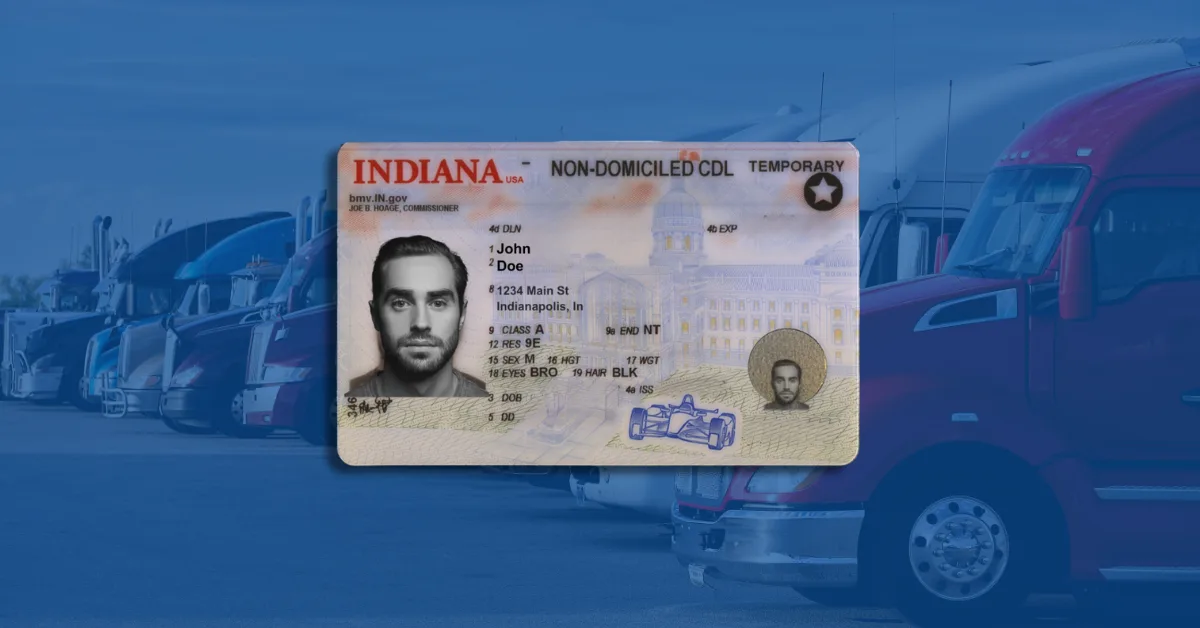
For organizations verifying CDLs, non-domiciled licenses pose unique challenges. The “non-domiciled” indicator is typically only printed on the front of the license, not encoded in the barcode. This creates some limitations; barcode-only scanners cannot detect non-domiciled status on most states’ IDs. To properly verify these IDs, organizations must use an ID scanning solution with Optical Character Recognition (OCR), which can read the printed text on the card.
Without OCR, and an ID verification software with templates for these IDs, it is impossible to confirm whether a CDL is non-domiciled, creating compliance risks for motor carriers, law enforcement, and employers in regulated industries.
What are non-domiciled CDLs?
A non-domiciled CDL is a commercial driver’s license issued to an individual who does not reside in the state, or even the country, where the license was obtained. By federal regulation, the word “Non-domiciled” must appear prominently on the CDL or Commercial Learner’s Permit (CLP), though it does not have to be directly next to the words “Commercial Drivers License” or “Commercial Learner’s Permit.”
There are two scenarios where a state may issue a non-domiciled CDL:
- Foreign nationals (excluding Canada and Mexico): An individual domiciled in a foreign country may obtain a CDL from a U.S. state if they meet all testing and licensing standards.
- Cross-state issuance during restrictions: An individual domiciled in one US state may obtain a non-domiciled CDL from another state if their home state is prohibited from issuing CDLs.
Importantly, Canadian and Mexican drivers are not eligible for non-domiciled CDLs, since commercial licenses from those countries are already recognized as meeting US standards.
Who qualifies for a non-domiciled CDL?
According to the FMCSA, the following are qualifications for receiving a non-domiciled CDL:
- Foreign drivers with an Employment Authorization Document (EAD) or an unexpired foreign passport with an approved CBP I-94 Arrival/Departure Record may obtain a non-domiciled CDL
- Drivers from Canada and Mexico must carry a valid commercial license from their home country
- Individuals with DACA status who are Mexican citizens may be eligible for a non-domiciled CDL, provided they have never held a Licencia Federal de Conductor from Mexico
These rules ensure that foreign drivers can legally and safely participate in the US trucking workforce, while maintaining alignment with federal safety standards.
Where are non-domiciled CDLs issued?
All 50 states and Washington, DC issue CDLs, but not all issue non-domiciled CDLs. Currently, seven states do not issue non-domiciled CDLs:
- Arkansas
- Mississippi
- Alabama
- Tennessee
- West Virginia
- New Hampshire
- Rhode Island
Read more about which states issue Non-Domicile CDLs and how.
Data on the total number of non-domiciled CDLs is limited. The FMCSA, CVSA, and AAMVA do not track this information nationwide. Reporting from Overdrive indicates that Texas and Illinois have issued the most non-domiciled CDLs; however, some large states like California, New York, New Jersey, and Georgia do not track issuance at all.
Why proper verification of non-domicile CDLs matters
Non-domiciled CDLs represent a small but important category of driver’s licenses. Failing to recognize the difference between a standard and non-domiciled CDL could result in:
- Allowing drivers who may not meet eligibility requirements to operate CMVs
- Noncompliance with FMCSA regulations
- Exposure to legal and financial liabilities
Investing in advanced ID verification software ensures that your organization can properly authenticate CDLs, whether standard, non-domiciled, or digital, by analyzing both printed data and barcode data against known templates.
As the freight and logistics industry continues to rely on foreign-born drivers to fill critical workforce gaps, non-domiciled CDLs will remain a key tool for enabling legal and compliant employment. However, their unique formatting makes them harder to detect without the right technology. By adopting ID verification solutions that include OCR capabilities, businesses and agencies can confidently verify non-domiciled CDLs, protect against fraud, and maintain compliance with federal regulations.