Skip to content


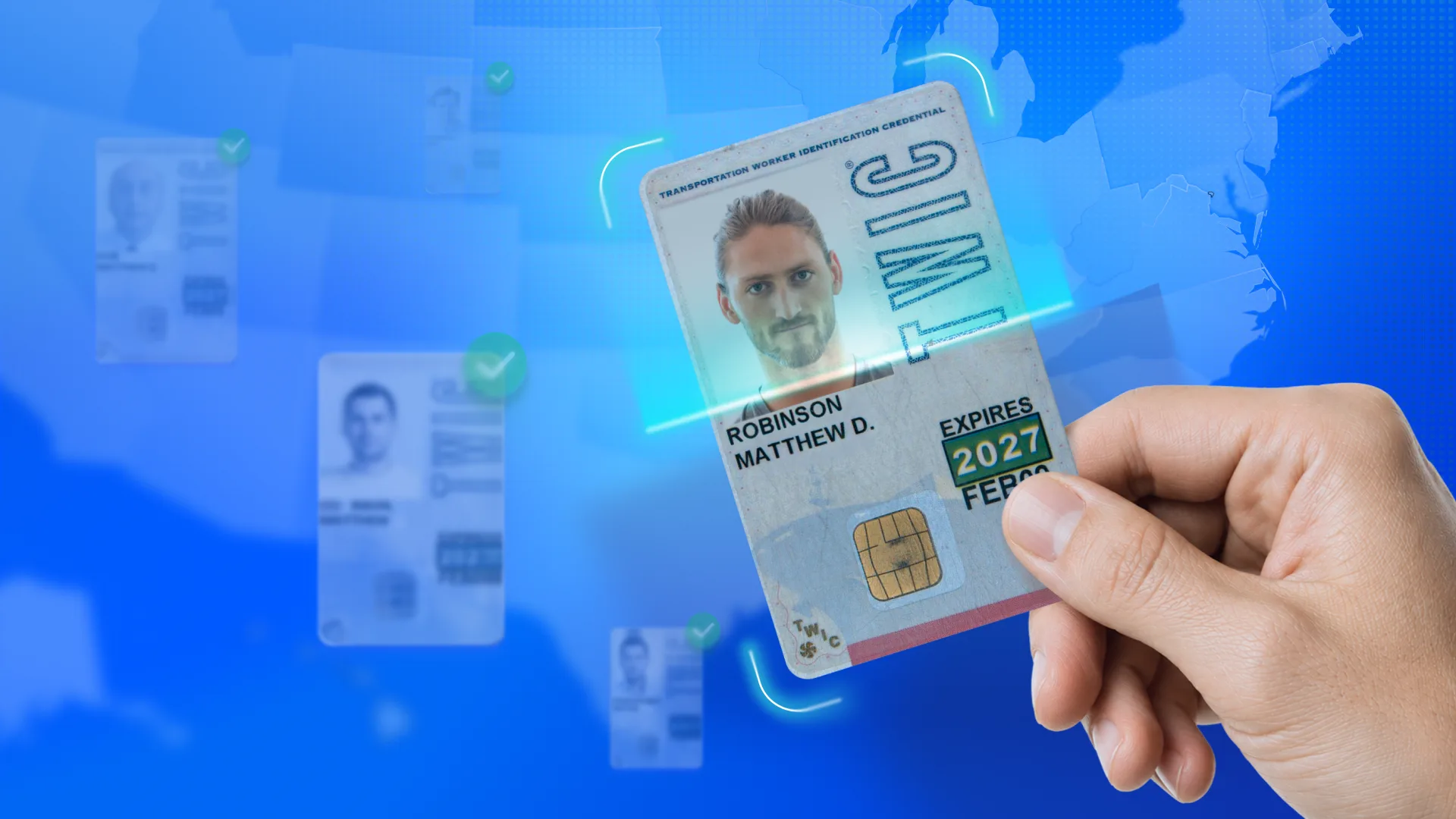

Every day, thousands of workers enter secure ports, cargo terminals, ships, and maritime facilities across the United States using a Transportation Worker Identification Credential (TWIC). While simply checking that someone is carrying a TWIC card may seem sufficient, visual inspection alone cannot confirm whether the credential is authentic, valid, or belongs to the person presenting it.
For organizations responsible for protecting critical infrastructure, verifying a TWIC card is an essential part of access control. In this guide, we’ll explain what a TWIC card is, who uses it, what information it contains, how it should be verified, and how IDScan.net helps organizations quickly authenticate them.
What is a TWIC card?
A Transportation Worker Identification Credential (TWIC) is a federal biometric identity credential issued by the Transportation Security Administration (TSA) in partnership with the U.S. Coast Guard. It was created under the Maritime Transportation Security Act (MTSA) to ensure that only vetted individuals are granted unescorted access to secure maritime facilities and vessels. Many logistics companies and freight carriers require drivers to obtain a TWIC card so they can access shipping terminals without requiring an escort. TWIC cards are primarily used throughout the U.S. maritime transportation industry, but they are required anywhere workers need routine access to secure port facilities or regulated vessels. Common users include port employees, longshoremen, dock workers, truck drivers picking up or delivering cargo, merchant mariners, harbor pilots, ship crews, terminal operators, maritime contractors, and Coast Guard-credentialed mariners.
Before receiving a TWIC card, applicants must complete:
- Identity verification
- Fingerprint collection
- A photograph
- A comprehensive TSA security threat assessment and background check
Approved applicants receive a tamper-resistant smart card that remains valid for five years before renewal is required.
What information appears on a TWIC card?
While a TWIC card resembles a standard government-issued photo ID, it contains significantly more advanced security technology designed to protect against fraud and unauthorized access. At first glance, a TWIC card may appear easy to inspect visually, but many of its most important security features cannot be verified without specialized hardware. Using a compatible TWIC reader, organizations can electronically capture and validate the credential’s data through optical character recognition (OCR), RFID technology, and the card’s embedded smart chip.
TWIC cards were specifically engineered to resist tampering, counterfeiting, and unauthorized duplication. Their contactless smart chip securely stores credential information and supports cryptographic authentication, making it substantially more difficult to forge than a traditional plastic ID. As a result, organizations responsible for securing ports, maritime facilities, and transportation hubs increasingly rely on electronic verification to confirm that a credential is authentic, has not expired or been revoked, and is being presented by its rightful owner.
Modern TWIC readers can verify several critical elements of the credential, including:
- The card was legitimately issued by the Transportation Security Administration (TSA)
- The credential is current and has not expired
- The card has not been revoked
- The card has not been reported lost or stolen
- The individual presenting the credential matches the biometric information stored on the card through fingerprint verification (when supported by the reader)
How are TWIC cards verified?
There are several levels of TWIC verification.
1. Visual Inspection
Many facilities simply inspect the card by checking:
- Photo matches the worker
- Expiration date
- General appearance
- Signs of alteration
While this is better than no verification, it provides little protection against identity fraud or invalid credentials.
2. Barcode or Credential Reading
Some access control systems electronically capture information printed on the credential.
This speeds up entry while reducing manual data entry errors but does not necessarily authenticate the credential itself.
3. Smart Card Verification
The highest level of verification uses a TWIC-compatible smart card reader.
These readers communicate with the embedded chip to verify:
- Digital certificates
- Card authenticity
- Credential validity
- Revocation status
- Fingerprint match (when configured)
Because verification occurs using cryptographic data stored inside the chip, this process is far more secure than relying solely on visual inspection.
Can TWIC cards be counterfeited?
Although TWIC cards incorporate advanced security features, they are not immune to fraud.
Criminals may attempt to use:
- Counterfeit cards
- Altered cards
- Expired credentials
- Stolen TWIC cards
- Borrowed credentials
- Digitally reproduced cards
A convincing fake may appear legitimate during a quick visual inspection, especially if security personnel are unfamiliar with genuine TWIC security features.
This is why many ports, logistics companies, and critical infrastructure operators rely on electronic credential verification rather than manual inspection alone.
Why TWIC verification matters
Unauthorized access to maritime facilities can create serious operational, financial, and security risks, making proper identity verification an essential part of any access control program. By verifying TWIC cards, organizations can help prevent unauthorized facility access, reduce identity fraud, detect counterfeit or altered credentials, improve regulatory compliance, strengthen physical security, protect valuable cargo and critical infrastructure, and maintain accurate digital access logs for audits and investigations. For ports, terminals, and other high-volume facilities that process thousands of workers each day, automated TWIC verification also streamlines the check-in process, reducing wait times and minimizing human error compared to manual document inspections.
Can IDScan.net verify TWIC cards?
Yes, IDScan.net supports verification of TWIC cards as part of its comprehensive identity verification and document authentication capabilities.
Using IDScan.net’s identity verification technology, organizations can:
- Read TWIC credential data
- Capture cardholder information automatically
- Verify the credential against built-in document templates
- Detect signs of document fraud or tampering
- Compare the credential photo with a live selfie using facial matching
- Integrate verification into visitor management, access control, and workforce onboarding systems
IDScan.net supports thousands of identity document types from around the world—including U.S. government-issued credentials like TWIC—allowing organizations to streamline identity verification while reducing fraud.
Final thoughts
A TWIC card is far more than a photo ID—it is a federally issued biometric credential designed to secure some of the nation’s most critical transportation infrastructure. While its embedded smart chip and security features make it difficult to counterfeit, organizations should never rely on visual inspection alone.
By electronically reading and verifying TWIC cards, ports, logistics companies, maritime employers, and critical infrastructure operators can reduce fraud, improve compliance, and ensure that only authorized personnel gain access to restricted areas.
With IDScan.net’s identity verification technology, organizations can quickly read and verify TWIC credentials alongside thousands of other government-issued identity documents, creating a faster, more secure access control process for every worker who enters the facility.