Skip to content


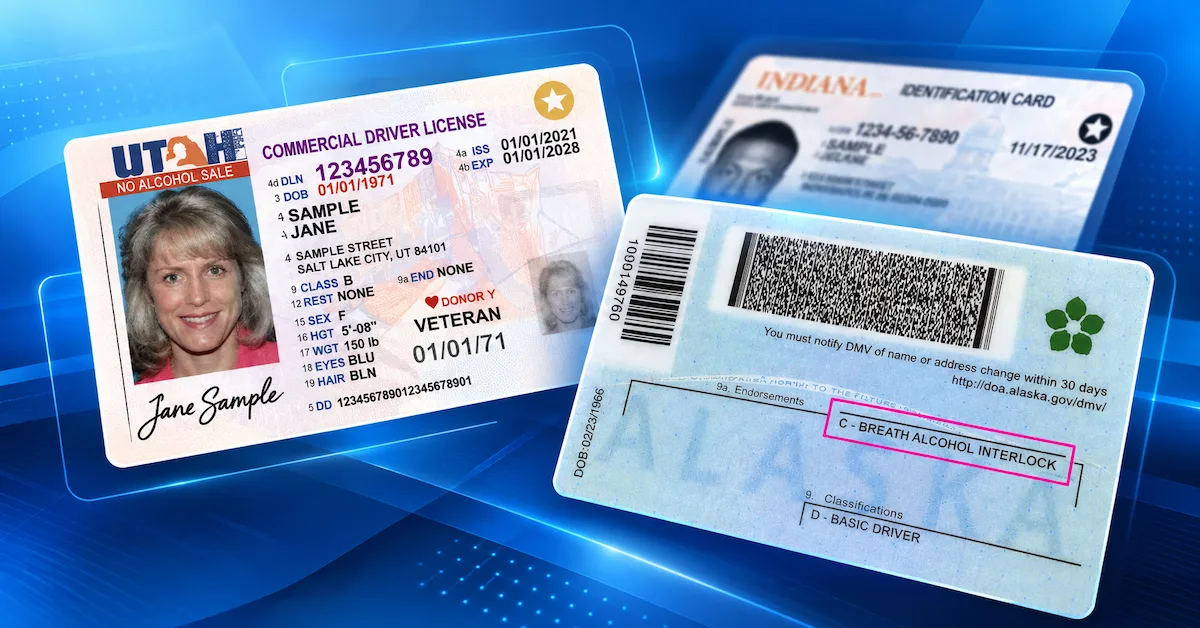

Interdict and interlock are two terms that can appear in conversations about driver’s licenses, DUI convictions, alcohol restrictions, and identity verification. Although they sound similar, and may even apply to the same individual, they represent two different types of restrictions.
An interdicted ID indicates that an individual is legally prohibited from purchasing alcohol. An ignition interlock restriction, on the other hand, limits the vehicles an individual may legally operate by requiring the use of an ignition interlock device.
Utah provides a particularly useful example of this distinction. Beginning January 1, 2026, Utah implemented a new interdicted-person identification system under HB 437. The state already had separate laws governing ignition interlock-restricted drivers.
Understanding the difference is increasingly important for businesses that sell alcohol, scan driver’s licenses, or use ID verification technology.
What is an interdicted ID?
An interdicted ID is a driver’s license or identification card that identifies someone who is legally restricted from purchasing alcohol.
Utah’s HB 437, Interdicted Person Amendments, created one of the most prominent current examples. Under the law, a court can designate certain individuals convicted of DUI as “interdicted persons.” Utah requires the designation in certain cases, including qualifying extreme DUI convictions, while courts have discretion in other circumstances. Individuals may also voluntarily apply for an interdicted credential.
The key point is that interdiction is an alcohol-purchase restriction.
Someone who is legally interdicted cannot purchase alcoholic beverages during the applicable interdiction period. The length of a court-ordered interdiction depends on the applicable law and court determination. Utah also permits voluntary interdiction, which must generally remain in place for at least 30 days before the individual can apply for a credential without the identifier.
What does an interdicted ID look like?
Utah makes interdicted credentials intentionally easy to distinguish visually.
The Utah Driver License Division states that an interdicted driver’s license or identification card includes a prominent red banner stating:
“NO ALCOHOL SALE”
Temporary credentials use a black-and-white version of the banner. Utah law also defines the interdicted-person identifier as including the “No Alcohol Sale” language and additional security features, including a prominent red stripe on the front of the credential.
This visual indicator is particularly important for alcohol retailers. Utah’s Department of Alcoholic Beverage Services (DABS) specifically instructs businesses to visually inspect Utah-issued IDs for the “No Alcohol Sale” designation when required.
What is an interlock ID?
“Interlock ID” is commonly used as shorthand for a driver’s license belonging to an ignition interlock-restricted driver. More precisely, the restriction applies to the person’s driving privileges rather than creating an entirely separate category of identification card.
An ignition interlock device, or IID, is installed in a vehicle and requires the driver to provide a breath sample before the vehicle can be started. If the measured alcohol concentration exceeds the device’s predetermined threshold, the vehicle will not start.
In Utah, an ignition interlock-restricted driver cannot legally operate a vehicle, including a motorcycle, unless it is equipped with the required ignition interlock device. The Utah Driver License Division updates the person’s driving record to reflect this restriction, and law enforcement can access the restriction.
Utah’s driver-license restriction system also uses restriction code “1” to indicate that the driver is required to have an ignition interlock device installed in the vehicle being operated.
Unlike an interdicted designation, the purpose of an ignition interlock restriction is therefore not primarily to prevent someone from purchasing alcohol. It controls how and under what conditions the person can legally drive.
Interdict vs. interlock: What’s the difference?
The easiest way to distinguish the two is to look at what activity each restriction regulates.
| Feature | Interdicted ID | Ignition Interlock Restriction |
| Primary purpose | Prevent alcohol purchases | Restrict operation of vehicles |
| Applies to | Alcohol purchasing/possession as provided by applicable law | Driving privileges |
| Connected to DUI offenses? | State dependent | Yes |
| Special physical ID indicator | Yes, Utah uses “NO ALCOHOL SALE” and a red banner | Driving restriction may be represented through restriction information and the driver’s record |
| Requires equipment in vehicle? | No | Yes, an ignition interlock device |
| Important to alcohol retailers? | Yes | Generally not for determining whether alcohol may be sold |
| Important to law enforcement? | Yes | Yes |
| Can both apply simultaneously? | Yes | Yes |
The important distinction is purchase restriction versus driving restriction.
An interdicted person is prohibited from purchasing alcohol during the applicable interdiction period. An interlock-restricted driver is prohibited from operating a vehicle that does not have the required ignition interlock device.
These statuses are not mutually exclusive.
Can someone be both interdicted and interlock restricted?
Yes.
In fact, the circumstances that trigger the two restrictions can overlap significantly. For example, Utah’s Driver License Division explains that a DUI conviction can result in an individual becoming ignition interlock restricted, while Utah’s newer interdiction law allows, and in specified circumstances requires, courts to designate people convicted of DUI as interdicted persons.
For example, a person convicted of a qualifying DUI could potentially be prohibited from purchasing alcohol while also being prohibited from driving a vehicle that does not contain an ignition interlock device.
The restrictions address different behaviors, so satisfying one restriction does not necessarily satisfy the other.
Do other states issue interdicted or interlock IDs?
Utah is not the only state that places alcohol, or ignition-interlock-related restrictions on driver’s licenses. However, the terminology, ID design, encoded information, and responsibilities placed on businesses vary considerably from state to state.
This distinction is important for businesses using ID scanners. There is no single nationwide “interdict” or “interlock” field that retailers can assume will appear identically on every driver’s license. In some states, a restriction is prominently printed on the physical credential. In others, it may appear as a restriction code, be associated primarily with the driver’s motor vehicle record, or require separate documentation.
Utah is particularly notable because its interdicted-person program directly connects the physical ID to alcohol-sale eligibility. Utah-issued interdicted IDs display “NO ALCOHOL SALE,” and alcohol licensees must check Utah credentials for that language before making a sale. Depending on the license type and transaction, Utah also requires electronic ID scanning.
States with alcohol-purchase restrictions displayed on IDs
Based on current state guidance, Alaska and Utah provide two of the clearest examples of states placing an alcohol-purchase restriction directly on a government-issued credential.
| State | Restriction | How It Appears on the ID | Alcohol Purchase Prohibited? | Special Electronic Scanning Requirement Tied to Restriction? |
| Alaska | Alcohol restriction | “ALCOHOL RESTRICTED” and a “J” restriction | Yes | No equivalent statewide electronic-scanning requirement identified |
| Utah | Interdicted person | “NO ALCOHOL SALE” prominently displayed on the credential | Yes | Utah requires electronic scanning in certain alcohol-sale environments, but interdiction must also be checked visually |
In Alaska, a court can prohibit an individual from purchasing alcohol. When this occurs, the Alaska DMV places a “J” restriction on the person’s driver’s license or identification card, and the words “ALCOHOL RESTRICTED” are printed on the credential. Alaska also allows an alcohol-restricted ID to be obtained in certain other circumstances, including self-imposed restrictions.
In Utah, an interdicted person’s state-issued ID contains the prominent “NO ALCOHOL SALE” designation. Utah alcohol licensees are instructed to visually check Utah-issued IDs for this language before selling alcohol.
The two systems are conceptually similar, but the compliance requirements are not identical. Businesses operating in multiple states should therefore avoid treating state-specific interdiction rules as a nationwide standard.
Which states put ignition interlock restrictions on driver’s licenses?
Ignition interlock requirements are much more widespread than alcohol-purchase interdiction programs. However, states handle the driver’s credential and driving record differently.
The following are examples where current state law or DMV guidance clearly establishes an IID-related driver’s-license restriction. This is not intended to mean these are the only states with ignition-interlock programs; rather, these examples illustrate how differently states represent and administer IID restrictions.
| State | Ignition Interlock Treatment | Physical Credential/Restriction | Relevant to Alcohol Sale? |
| Alaska | “C” restriction | Back of license states “IID REQUIRED”; limited licenses state “Ignition Interlock Device Required” | No |
| California | IID-restricted driver’s license | Driving privilege restricted to vehicles equipped with an IID | No |
| Indiana | Restriction 6 | Driver’s license restriction indicates ignition interlock requirement | No |
| New York | IID may be imposed as a driving restriction | Restriction is associated with the individual’s driving privileges and IID requirements | No |
| South Carolina | Ignition interlock restricted license | State law requires the license to conspicuously identify the IID restriction | No |
| Virginia | Restricted driving privileges can require IID | IID is imposed as a condition of restricted driving privileges | No |
| Utah | Ignition interlock restriction | IID restriction applies to the person’s driving privileges/record | No |
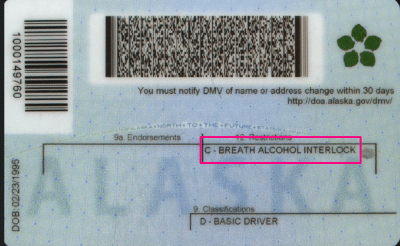
Alaska provides perhaps the clearest comparison because it distinguishes both types of restrictions on its credentials. The state’s “J” restriction means the individual is restricted from purchasing alcohol, while its separate “C” restriction means an ignition interlock device is required. The back of an affected license states “IID REQUIRED.”
California allows qualifying drivers to obtain an IID-restricted driver’s license. The restriction limits the person to operating vehicles equipped with an ignition interlock device.
Indiana uses Restriction 6 for an ignition interlock device. The Indiana Bureau of Motor Vehicles states that the restriction can be applied when a court requires an IID following an operating-while-intoxicated case or under other qualifying circumstances.
New York can similarly impose an ignition interlock restriction on driving privileges. Depending on the circumstances, a driver seeking restoration after revocation may be approved with an IID requirement.
South Carolina is especially explicit about how the restriction appears on the license. State law requires an ignition-interlock-restricted license to “conspicuously identify” that the individual may only operate a motor vehicle equipped with an ignition interlock device.
Virginia allows restricted driving privileges that require operation of a vehicle with an ignition interlock device installed. The Virginia DMV treats the IID as a condition of the individual’s driving privileges rather than as an alcohol-purchase restriction.
The important point for retailers is that none of these ignition-interlock restrictions should automatically be interpreted as a prohibition against purchasing alcohol. An IID restriction generally governs driving behavior, while an interdicted or alcohol-restricted credential can directly govern whether alcohol may legally be sold to that individual.
Do businesses need to scan interdicted or interlock IDs?
There is no uniform nationwide requirement requiring retailers to electronically scan IDs specifically to detect an interdicted or ignition-interlock status.
Utah’s system is particularly important for businesses because it combines alcohol-sale restrictions with specific ID-checking and electronic-scanning requirements. However, even in Utah, electronically scanning an ID and checking for interdiction are not necessarily the same step.
Current Utah DABS guidance requires bars and taverns to check and electronically scan every ID before entry. Employees must also visually inspect Utah-issued credentials for “NO ALCOHOL SALE.” Restaurants must electronically scan IDs for customers purchasing alcohol who appear to be 35 or younger. Off-premise retailers must check IDs for all alcohol purchases, while ID scanning is specifically required for curbside, drive-through, and designated loading-area alcohol pickups rather than ordinary in-store purchases.
That distinction matters because a successful barcode scan should not automatically be interpreted as authorization to sell alcohol.
Why businesses should not treat interlock and interdict restrictions the same
For alcohol retailers, the difference between these restrictions is significant.
An interdicted or alcohol-restricted ID can directly affect whether the transaction is legal. If the jurisdiction prohibits alcohol sales to the credential holder, employees need to recognize the applicable designation and decline the sale.
An ignition-interlock restriction generally does not make the person ineligible to purchase alcohol. Instead, it limits the person’s ability to operate a motor vehicle unless the vehicle meets the applicable IID requirements.
This is particularly clear in Alaska, where the state uses separate restriction codes for the two concepts. A “J” restriction indicates that the individual is restricted from purchasing alcohol, while a “C” restriction indicates an ignition interlock requirement.
Businesses should therefore avoid creating a blanket policy that automatically rejects alcohol sales whenever an ID contains a DUI-related or ignition-interlock restriction. Instead, employees and ID verification systems should distinguish between restrictions affecting purchasing eligibility and restrictions affecting driving privileges.
Can an ID scanner detect an interdicted ID?
This is where the distinction between scanning an ID and visually inspecting an ID becomes particularly important.
When Utah first introduced interdicted IDs, DABS specifically warned businesses that existing ID scanners might not identify whether a customer is an interdicted person. The agency instructed employees to rely on a visual inspection for the “No Alcohol Sale” language.
That means businesses should not assume that simply receiving a successful barcode scan means an alcohol sale is permitted.
An ID scanner can still perform valuable functions such as reading identity information, calculating age, supporting document verification, etc. But when a state places legally significant information prominently on the physical credential, businesses may also need a visual inspection workflow.
This is a good example of why ID parsing, ID verification, ID authentication, and regulatory compliance are related but separate functions.
How IDScan.net can help businesses verify IDs
Businesses that sell age-restricted products increasingly need to evaluate more than the date of birth printed on an ID.
ID scanning solutions can help businesses automate identity data capture, calculate age, identify expired credentials, maintain configurable scan records, and support ID verification and authentication workflows. Depending on the workflow and hardware being used, businesses can combine electronic ID scanning with employee visual inspection procedures for state-specific indicators and compliance restrictions.
For businesses operating in states such as Utah, the introduction of interdicted IDs also reinforces the importance of keeping ID verification procedures current as state credential formats and alcohol regulations change.
Final thoughts
Although “interdict” and “interlock” sound similar, they describe fundamentally different restrictions.
An interdicted ID tells a business that the individual is prohibited from purchasing alcohol. An ignition interlock restriction tells the driver, and law enforcement, that the individual may only operate a vehicle under specific ignition-interlock requirements.
For businesses, particularly alcohol retailers, the distinction matters. Age verification alone may not provide every piece of information necessary to determine whether a transaction is legally permitted. Utah’s introduction of the “NO ALCOHOL SALE” credential demonstrates how visual ID indicators, barcode scanning, age verification, and regulatory compliance can all play different roles in the ID-checking process.
As states continue updating driver’s license formats and the rules surrounding age-restricted purchases, businesses should ensure that their ID verification policies account for both the information encoded in an ID and legally significant information displayed visually on the credential.