Skip to content



Compare two best-in-class forensic document readers
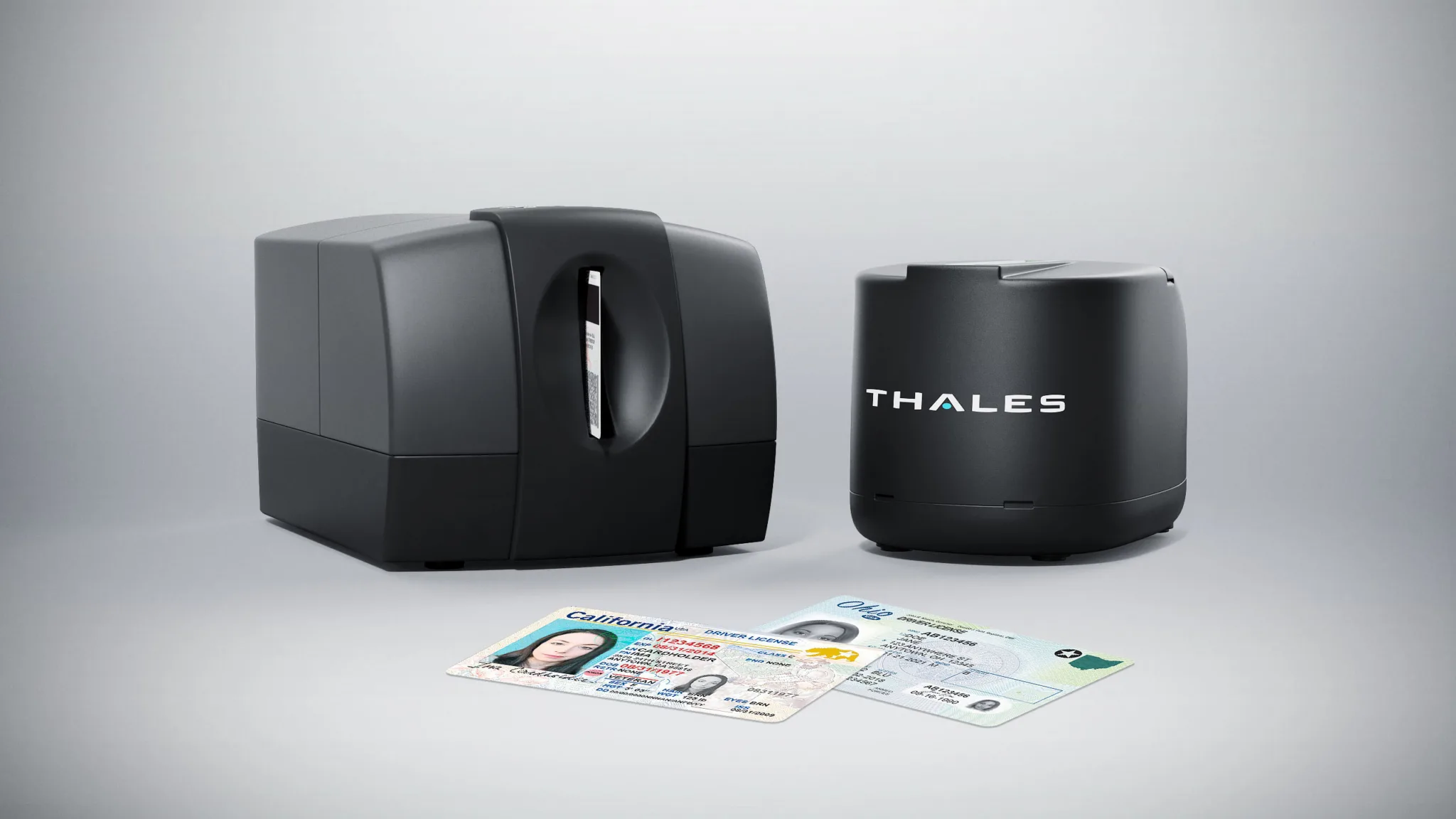
We maintain two scanners in our fleet which are optimized for ID authentication of drivers licenses, ID cards, and ICAO-sized documents. Here we compare and contrast the two options for ID scanning for your business.
The Thales CR5400 is a lightweight, drop-in scanner. The ID is inserted vertically, and a motorized engine lifts the ID after scanning. The E-Seek M500 is a heavy-duty, highly durable device, with a side-load slot for the ID. Both are ID-card only devices – they don’t have a flatbed to scan passports or other irregularly sized documents. Both have a motorized slot that pulls in and ejects the ID. Both capture high-resolution images of the ID under multiple light wavelengths (called a “duplex scanner”).
About the Thales CR5400
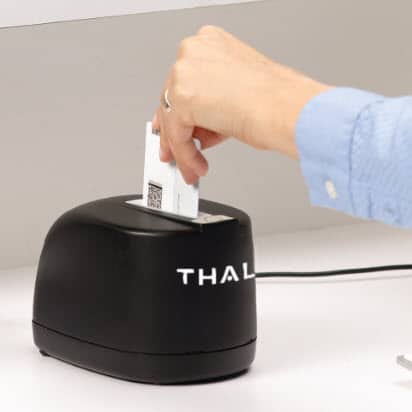
The Thales CR5400 has been a mainstay of the Thales fleet for many years, surviving the sale of the ID scanner unit from 3M to Gemalto, and the acquisition by Thales. There are tens of thousands of these scanners in circulation, and they are particularly popular with schools, fitness centers, religious organizations, and non-profits.
The reader supports orientation-independent scanning (ie. you can insert the ID in any direction). Authentication takes between 8-10 seconds. Authentication result triggers a red/yellow/green illumination of the LED light which wraps around the ID slot.
The primary benefit of the Thales CR5400 is that it is a one-cable device. It draws power directly from the computer, and is very lightweight. This means it could easily be moved alongside a computer for a mobile check-in station, and can be used in locations without access to a power source.
The fact that the ID slot faces upward does make the device less ideal for industrial environments and locations with heavy dust, since particles can easily get trapped inside the scanner. It also requires a stronger motor to lift the ID out of the slot, which is a moving part that can break more frequently. The CR5400 can be difficult to adequately clean, and Thales does not offer a dedicated cleaning kit.
How to scan an ID with the Thales CR5400
Shop the Thales CR5400
About the E-Seek M500
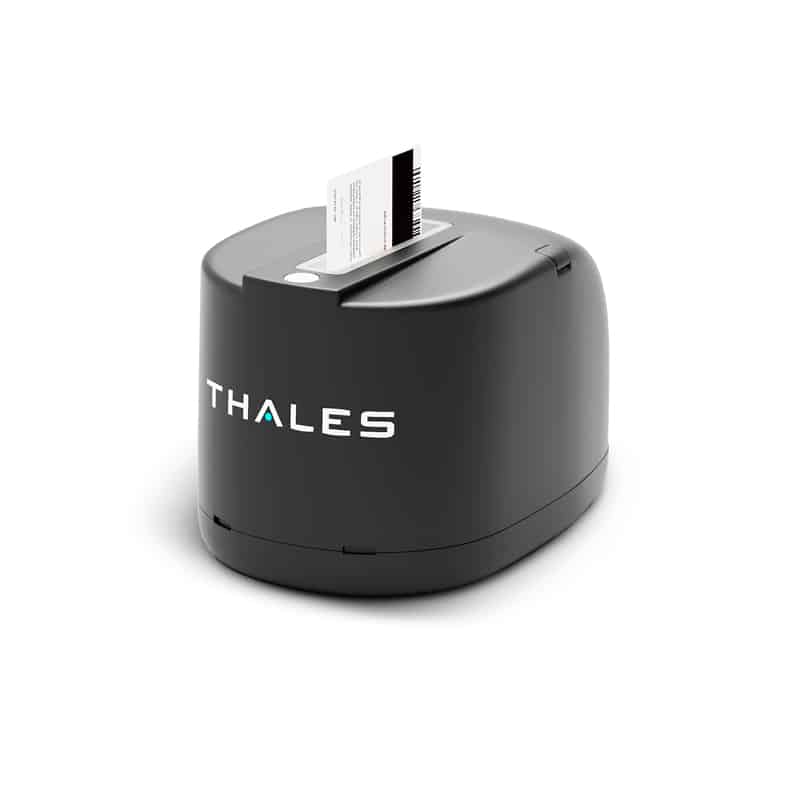
The E-Seek M500 may look familiar if you’ve ever had your ID scanned by TSA. It is a forensic document reader known for its durability for high-volume scanning environments. Because the largest user of this device is the TSA – one of the highest volume scanning entities in the world – E-Seek has engineered the device to be repairable, cleanable, and extremely easy to use. It authenticates quickly, seldom breaks, and can go 3,000 scans without needing cleaning, which is why we frequently recommend it for auto rental, security, cargo and freight use cases.
The E-Seek requires both a connection to a computer as well as an external power source, making it less portable. It is also a heavier device, with a larger desk footprint. However, its larger shape and size makes it more durable and better for very high volume ID scanning.
How to scan IDs using the E-Seek M500
Shop the E-Seek M500

What is the difference between the two scanners?
The two devices, when used with ID scanning software, will produce exactly the same ID authentication results. There is no difference in efficacy of fake ID detection. The differences primarily come down to environment where the device will be used. For office environments and lower volume scanning, the CR5400 is a lightweight and flexible device. For higher volume scanning, or environments which require more durability, the M500 is ideal.
Contact us if you need assistance selecting the right ID scanner.