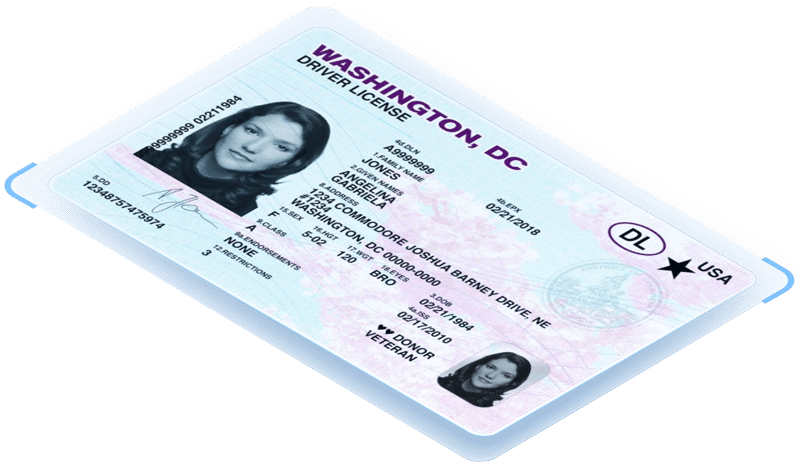
AI-generated fake IDs are no longer a theoretical threat. They’re being used right now, and the tools claiming to catch them aren’t all created equal. We put TruthScan, one of the newer AI detection platforms on the market, through a rigorous test using three categories of ID images to see whether it could hold up in a real-world business environment.
The short answer: it can’t, at least not reliably enough to trust for ID verification.
What is TruthScan?
TruthScan is an AI image and deepfake detection tool built to analyze images, video, audio, and text for signs of AI generation. It’s marketed as capable of detecting AI-generated IDs and drivers licenses specifically, and claims 99% accuracy with sub-second processing. The platform is led by the CEO of Undetectable AI, a company that sits on both sides of the AI content fence, both generating and detecting AI content.
On paper, TruthScan checks several boxes: an easy-to-use dashboard, heatmap visualizations showing why a document was flagged, and a free tier to get started. But real-world performance is what matters for businesses making identity verification decisions.
How we tested TruthScan
We ran TruthScan against three distinct sets of ID images:
- AI-generated ID images: Synthetic IDs produced using AI tools
- Photos of legitimate IDs: Images taken on an iPhone 16 Pro in good lighting, on various real-world backgrounds (plain black surface, desk, carpet)
- Photos of traditional fake IDs: Physical counterfeit IDs, also photographed on an iPhone 16 Pro under the same conditions
The results
AI-Generated IDs: 71% Detection Rate
TruthScan correctly flagged 71% of AI-generated images as “Synthetic.” The remaining 29% were classified as “Likely Real,” meaning nearly 1 in 3 AI-generated fake IDs slipped through undetected.
For a tool claiming 99% accuracy, a 71% detection rate on the exact threat it’s designed to catch is a significant gap.

Legitimate IDs: 57% False Positive Rate
This is where the results became most concerning. Every ID in this set was real, photographed on a standard modern smartphone. TruthScan incorrectly flagged 57% of them as AI-generated, with AI Probability scores ranging from 53% to 94%.

The reasoning TruthScan provided for these false flags revealed some fundamental misalignments with how IDs actually look and work:
- “Presence of a handwritten signature on the license” Signatures are a standard feature of drivers licenses. Flagging one as a sign of AI generation suggests the model lacks familiarity with the documents it’s supposed to evaluate.
- “Unnaturally perfect presentation of the license on the carpet” The carpet in question was recently cleaned. That’s not AI. That’s a vacuum.
- “Lack of original metadata” All phone-captured images in our test had similar metadata, making this flag inconsistent and unexplained.
- High image quality Flagging a photo for looking too good is a known weakness of AI detection tools, but it’s a particularly poor signal when modern smartphones routinely produce high-resolution images.

A 57% false positive rate means more than half of legitimate customers would be incorrectly flagged as potential fraudsters. For any business using this as a verification layer, that’s an unacceptable risk — both operationally and from a customer experience standpoint.
Traditional Fake IDs: Flagged for the Wrong Reasons
TruthScan classified 67% of the physical counterfeit IDs as “Real but Digitally Edited” and 33% as “Synthetic” or “Likely Synthetic.” None of these IDs were digitally altered or AI-generated; they were physical fakes photographed with a phone.
Interestingly, some of the reasoning for IDs it did flag included legitimate-sounding observations: font inconsistencies, alignment errors. But these were mixed in with more false flags, including flagging a DMV watermark that appears on many legitimate ID templates as suspicious.
The net result: TruthScan was catching some of these IDs for the wrong reasons, and missing others entirely. That’s not a foundation any business can rely on.
Why ID fraud detection matters for your business
The fake ID threat has evolved. AI tools have made it easier than ever to produce convincing synthetic IDs at scale, and that’s a real problem for businesses that rely on identity verification, whether in age-restricted retail, financial services, hospitality, or any regulated industry.
But a detection tool that flags more than half of legitimate IDs as fake, while missing nearly a third of actual AI-generated ones, introduces a different kind of risk. Businesses lose real customers, create friction for good-faith users, and still aren’t protected against the sophisticated fakes they’re trying to catch.
This reflects a broader truth about AI detection tools right now: false positives are a systemic problem across the industry. TruthScan is not alone in this, but it doesn’t perform well enough to be trusted as a primary defense layer for ID verification.
What actually works: A layered approach
No single AI detection tool is sufficient on its own, especially for enterprise businesses operating at scale or in high-risk categories. The most effective ID verification strategies use multiple layers of checks that work together.
Our own testing across thousands of ID images has shown that our core digital ID verification engine, which uses algorithmic image and symbology analysis, catches 85% of AI-generated fake IDs on its own. When combined with third-party database checks, that figure rises to 99.6%.
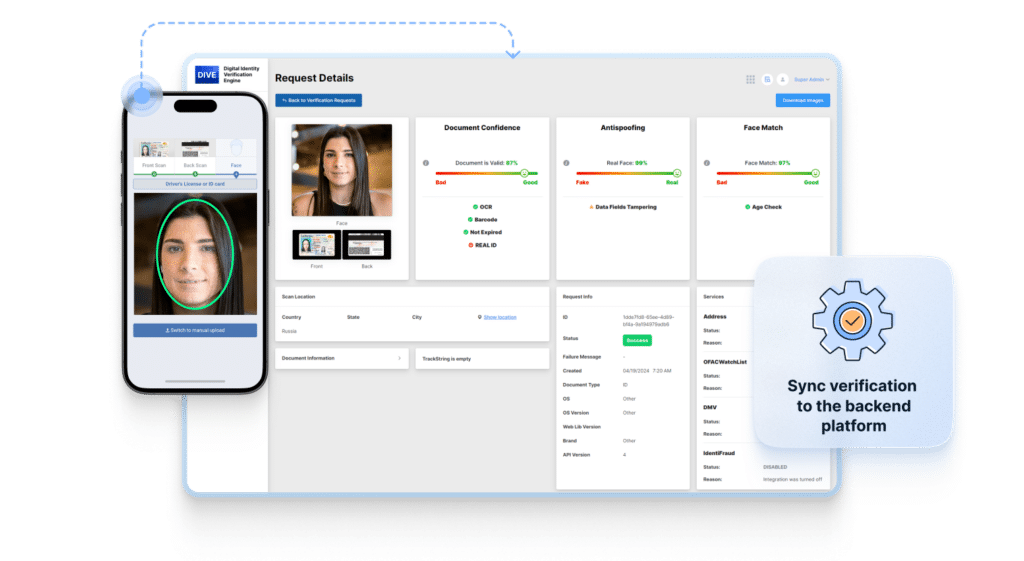
For remote or digital verification scenarios, where a physical ID is never in hand, the most robust approach includes:
- Front, back, and crossmatch document verification to validate the ID itself
- Biometric matching that compares the user’s face to the document photo in real time
- Liveness detection with randomized checks to prevent the use of AI-generated images or video
- Third-party database checks for an additional layer of risk data
This kind of layered, purpose-built system is what separates a reliable verification solution from a general-purpose AI detection tool applied to a problem it wasn’t designed to solve.
Conclusion
TruthScan has a clean interface and some interesting features. But based on our testing, it is not a trustworthy tool for ID verification. It misses too many AI-generated fakes, and it incorrectly flags too many legitimate IDs.
For businesses that need to actually catch fraudulent IDs without turning away real customers, the answer isn’t a single AI detection layer. It’s a verification system built specifically for documents, backed by multiple validation methods that work together.
If your business is worried about the threat of AI-generated IDs, contact us to see how we can combat all types of identity fraud.
Can TruthScan detect AI-generated IDs or drivers licenses?
TruthScan markets itself as a reliable AI detection tool for IDs and drivers licenses, but our testing tells a different story.
- TruthScan claims 99% accuracy, but our real-world testing found significant performance gaps when applied to ID verification
- Only 71% of AI-generated IDs were correctly flagged
- 57% of legitimate IDs were falsely flagged as AI-generated, putting real customers at risk of being turned away
- The reasoning behind many flags showed a lack of familiarity with standard ID features
No single AI detection tool is sufficient for enterprise ID verification; the fraud landscape is too sophisticated and too fast-moving.