
How good does it get? An honest look into the quality of foreign-made fake IDs
It’s a quiet Friday night at a suburban liquor store. A teenager nervously hands over a Missouri driver’s license to the clerk behind the counter. The card looks pristine. It’s thick, the holograms catch the light, the photo matches his face, and the barcode even scans, verifying his age as 23 (the most common age used on fake IDs by minors looking to age themselves up).
The clerk gives it a glance, shrugs, and hands over two cases of cheap beer. The teenage customer walks out triumphant. But what the clerk didn’t realize is that the ID in their hand was one of thousands printed and shipped from a sophisticated fake ID ring in China.
Fake ID creation is big business. Just last month, a man in Los Angeles was caught with more than 3,000 fake IDs. Much like counterfeit bags and sneakers, China, Hong Kong, and Taiwan are now the epicenters for thriving black markets in fake IDs, purchased on the darkweb for as little as $20. These IDs are used both by college students looking to fudge their age and nefarious fraudsters looking to commit bank theft. These are not your McLovin ID, and the cat-and-mouse game between fake ID manufacturers and fraud prevention technology has escalated into an all-out war. Law enforcement and fraud prevention experts are raising the alarm: these fakes aren’t just getting better. In many cases, they’re getting nearly undetectable. Nearly.
A New Era of Counterfeiting
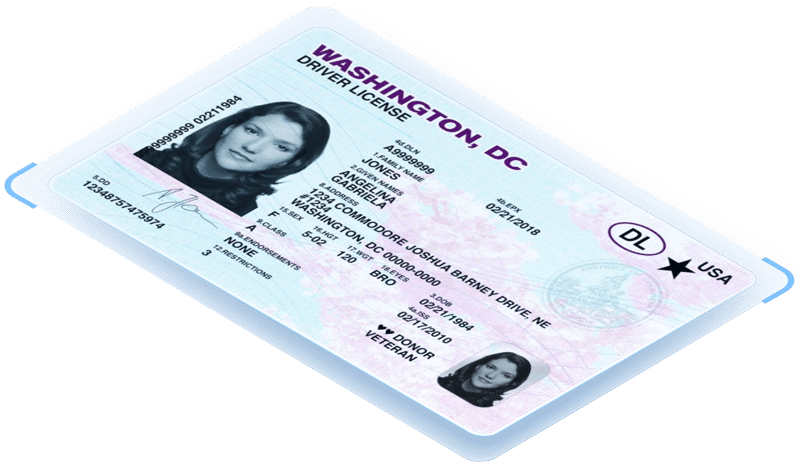
For years, the stereotype of a fake ID was a flimsy piece of plastic with the wrong font and a bad photo. Not anymore. Modern Chinese counterfeiters operate with shocking precision and professionalism, investing in the same printing technologies, card stock, and security features used by government agencies in the U.S. and Europe. A fake ID purchased today can be expected to have:
- Holograms and watermarks
- Print that is high-resolution enough for microprints
- Texture and raised features
- Windowpanes, holograms, and other security features
The IDs typically ship in a phony package – stuffed inside a pair of socks, under the mirror in a cosmetics case, or stuffed in the pages of a book. From the time you order the fake IDs, complete the bitcoin transfer (though some manufacturers take credit cards, making it extra easy), and receive the counterfeit document is usually less than two weeks.

Why have Chinese-made fake IDs gotten so good?
They can replicate security features like guilloché patterns and OVD (optically variable devices) with unnerving accuracy. In some cases, they’ve reverse-engineered the materials used in state-issued cards, including Teslin and polycarbonate blends. In most cases they have access to the same printing machines and cardstock used by the government and issuing authorities.
How are fake ID manufacturers getting access to ID templates?
Fraud rings operate in the US and steal legitimate IDs and send them back to China to be reverse-engineered. States also often release high-resolution templates of new ID formats online, and include lists of security features, so the manufacturers can get started on their printing plates as soon as the new ID format is announced.
Who is buying Chinese-made fake IDs?
It isn’t just college kids. Fake IDs form the basis of many types of fraud.
- Fraudulent equipment and car rental
- Loan fraud and use of stolen identities to withdraw funds
- Apartment rental scams using fake IDs
- Fictitious pickups for cargo theft scams
Creation of a fake or synthetic identity is at the root of billions of dollars in fraud annually.
So, we bought some foreign-made fake IDs
In June, we ordered 10 foreign-made fake IDs from several darkweb sites. We used images of our team members, but bogus identities. We bought the IDs using Bitcoin and an anonymous transaction. The IDs came inside the sole of a fuzzy slipper.
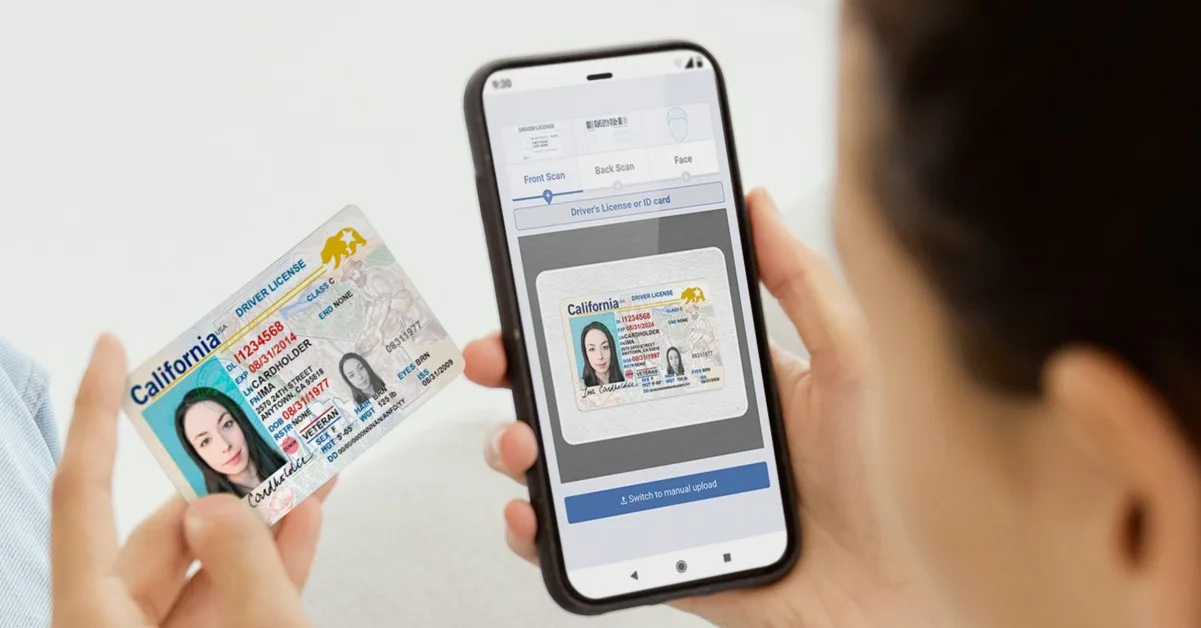
And then we tested them using our VeriScan ID Authentication to see just how good these sophisticated fake IDs really are.
The results
Out of ten foreign-made fake IDs put to the test, our technology successfully flagged nine as fraudulent—an industry-leading accuracy rate. The 10th fake ID, which initially fooled our system, was easily caught with the addition of a third party check, which flagged the synthetic identity used on the ID.
These weren’t crude counterfeits. They were high-quality fakes, complete with scannable barcodes and realistic holograms, designed to slip past untrained eyes and basic scanners. But our system saw what others couldn’t.
How we caught these sophisticated fake IDs
Document authentication doesn’t rely on a single method to detect these fake IDs. It used a combination of checks, which are continuously being enhanced as our systems analyze and scan more IDs. In the case of Chinese-made fake IDs, we found several common reasons we were able to catch them (which we will not go too in-depth on, so as not to empower the fake ID manufacturers):
- Issues with face images and photos
- Failure to properly recreate security features in all light wavelengths
- Improper barcode syntax specific to jurisdictions
We found other anomalies, but these were three key areas in which our software was consistently able to catch fake IDs. However, these IDs could only reliably be caught using ID authentication. Visual inspection or a basic barcode scan is likely to miss that these IDs are counterfeit.
This test highlights the growing sophistication of fake IDs and why legacy tools alone are no longer enough. While the fakes we examined could have passed at countless banks or access points, our technology caught them in seconds. As foreign-made IDs continue to flood into the U.S., it’s more important than ever to adopt multi-layered, forensic-grade ID verification that stays one step ahead of the fraudsters.
Are Chinese-made fake IDs getting too good?
Not yet. Chinese-made fake IDs are increasing in quality and their ability to mimic the security features of legitimate IDs, but they can still be caught by ID authentication. In order to catch these sophisticated fakes, you should ensure your ID scanning technology includes:
- Image analysis, especially facial geometry technology
- Continuous training on barcode syntax for new ID formats
- Ability to layer on checks from third party sources
- Multiple light wavelength examination